
Search
Remove Ads
Advertisement
Search Results
Article
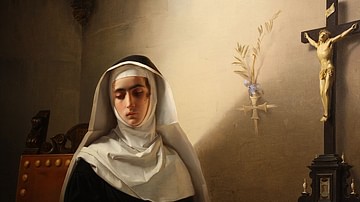
The Daily Life of Medieval Nuns
Monasteries were an ever-present feature of the Medieval landscape and perhaps more than half were devoted solely to women. The rules and lifestyle within a nunnery were very similar to those in a male monastery. Nuns...

Article
Why the Industrial Revolution Started in Britain
The Industrial Revolution saw a wave of technological and social changes in many countries of the world in the 18th and 19th centuries, but it began in Britain for a number of specific reasons. Britain...

Article
Causes of the American Revolution
The American Revolution (c. 1765-1789) was a definitive event in Western history that saw the emergence of the United States and helped spawn additional waves of revolutions and societal upheavals on both sides of...

Article
North Africa’s Place in the Mediterranean Economy of Late Antiquity
The Mediterranean Sea was the economic focal point of the Roman Empire. Rome's armies first established an empire across these waters beginning back in the times of the Roman Republic...

Article
The Sea Dogs - Queen Elizabeth's Privateers
The sea dogs, as they were disparagingly called by the Spanish authorities, were privateers who, with the consent and sometimes financial support of Elizabeth I of England (r. 1558-1603 CE), attacked and...

Article
Caesarea Maritima's Role in the Roman Empire
Caesarea Maritima, the city Herod the Great (r. 37-4 BCE) built for Rome on the southeastern coast of the Mediterranean served as the Roman Empire's powerbase of operations both commercially and militarily...

Article
Cosmetics, Perfume, & Hygiene in Ancient Egypt
For the ancient Egyptians life was a celebration, and so, just as one would want to look one's best at any party, personal hygiene was an important cultural value. The Egyptians bathed daily, shaved their...

Definition
Mercury (Deity)
Mercury (Mercurius) was the Roman god of commerce, often serving as a mediator between the gods and mortals, his winged feet giving him the advantage of speed, and so was the patron of circulation in general - of people, goods...

Definition
Roman Coinage
Roman coins were first produced in the late 4th century BCE in Italy and continued to be minted for another eight centuries across the empire. Denominations and values more or less constantly changed but certain types such as the...

Definition
Templo Mayor - The Aztecs' Greatest Temple
The Templo Mayor or Great Temple (called Hueteocalli by the Aztecs) dominated the central sacred precinct of the Aztec capital Tenochtitlan. Topped by twin temples dedicated to the war god Huitzilopochtli and...
