
Search
Remove Ads
Advertisement
Search Results
Definition
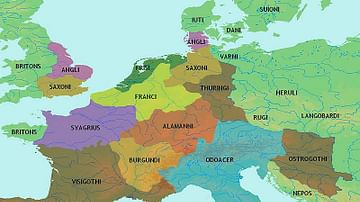
Alemanni
The Alemanni (also known as the Alamanni and the Alamans, meaning "All Men" or "Men United") were a confederacy of Germanic-speaking people who occupied the regions south of the Main and east of the Rhine rivers in present-day Germany...

Definition
Cahokia
Cahokia is a modern-day historical park in Collinsville, Illinois, enclosing the site of the largest pre-Columbian city on the continent of North America. The original name of this city has been lost – Cahokia is a modern-day designation...

Article
The Megalithic Funerary Art of San Agustín
Beginning approximately 2000 years ago, in a rugged stretch of southwestern Colombia where the Andes split into multiple ranges and the mighty Magdalena River is born, a people created a collection of magnificent...

Article
The Royal Macedonian Tombs at Vergina
Excavations at Vergina in northern Greece in the late 1970s CE unearthed a cluster of tombs thought to be the burial site of Philip II (r. 359-336 BCE), the father of Alexander the Great (r. 336-323 BCE), with...

Article
The Dexileos Stele: A Study of Aristocracy and Democracy in Greek Art
The Dexileos Stele assesses the way that Athenian political thought penetrated all levels of society, showing the conflict that the aristocratic classes were faced with in trying to find...

Article
Shabti Dolls: The Workforce in the Afterlife
The Egyptians believed the afterlife was a mirror-image of life on earth. When a person died their individual journey did not end but was merely translated from the earthly plane to the eternal. The soul...

Article
Inca Mummies
The Inca civilization of Peru, as with many other ancient Andean cultures, mummified many of their dead and buried them with valuable materials such as precious metal jewellery, fine pottery, and sumptuous textiles. Important mummies...

Article
North Africa’s Place in the Mediterranean Economy of Late Antiquity
The Mediterranean Sea was the economic focal point of the Roman Empire. Rome's armies first established an empire across these waters beginning back in the times of the Roman Republic...

Article
The Sea Dogs - Queen Elizabeth's Privateers
The sea dogs, as they were disparagingly called by the Spanish authorities, were privateers who, with the consent and sometimes financial support of Elizabeth I of England (r. 1558-1603 CE), attacked and...

Article
Caesarea Maritima's Role in the Roman Empire
Caesarea Maritima, the city Herod the Great (r. 37-4 BCE) built for Rome on the southeastern coast of the Mediterranean served as the Roman Empire's powerbase of operations both commercially and militarily...
