
Search
Did you mean: Gaia?
Remove Ads
Advertisement
Search Results

Definition
Nisaba
Nisaba (also Naga, Se-Naga, Nissaba, Nidaba, and associated with Nanibgal) is the Sumerian goddess of writing, accounts, and scribe of the gods. Although her name is commonly given as Nidaba, noted scholar Jeremy Black points out that "the...

Article
Threshing Floors of the Bible
The threshing floors of the Bible were outdoor stone floors, usually circular in fashion, used by farmers to process the grain of their crops. For the larger community, like watermills of the recent past, they could be gathering places bustling...

Article
Why Poland-Lithuania Disappeared
The Polish-Lithuanian Republic (1569-1795) was one of the largest and most populous states in Early Modern Europe, yet in 1795, its last remnants were partitioned between Austria, Prussia, and Russia. Here we take a look at the reasons why...

Article
Hymn to Nisaba
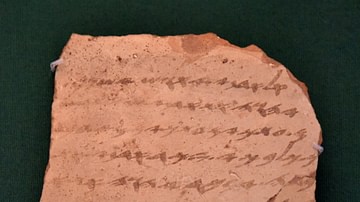
The Hymn to Nisaba (c. 3rd millennium BCE) is a poem praising Nisaba, the Sumerian goddess of writing and accounts who also served as scribe of the gods. The poem is officially dedicated to Enki, the god of wisdom (sometimes given as her...
Definition
Ancient Judean Technology
Though the kingdom of Judah was not particularly notable in terms of technological developments, technology, nonetheless, played a central role in its rise as a political power in the region. Emerging in the 10th century BCE, it reached its...

Definition
St. Anthony's Fire
St. Anthony's Fire (SAF) is an illness brought on by the ingestion of fungus-contaminated rye grain causing ergot poisoning (ergotism). The disease's common name derives from the medieval Benedictine monks dedicated to that saint who offered...

Article
Agriculture in the Fertile Crescent & Mesopotamia
The ancient Near East, and the historical region of the Fertile Crescent in particular, is generally seen as the birthplace of agriculture. The first agricultural evidence comes from the Levant, from where it spread to Mesopotamia, enabling...

Article
The Curse of Agade - Naram-Sin's Fictional Battle with the Gods
The Curse of Agade (also given as The Cursing of Agade) is a poem dated to the Ur III period of Mesopotamia (circa 2112 to circa 2004 BCE), though it is thought to be somewhat older in origin. It tells the story of the Akkadian king Naram-Sin...
Definition
Persephone
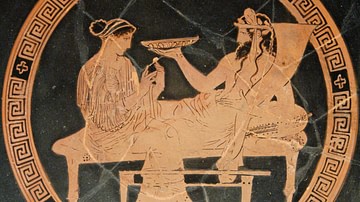
Persephone (aka Kore) was the Greek goddess of agriculture and vegetation, especially grain, and the wife of Hades, the ruler of the Underworld. Persephone was an important element of the Eleusinian Mysteries and the Thesmophoria festival...

Article
Paul's Journeys and the Mediterranean Trade
Mediterranean trade increased exponentially at the turn of the first millennium. During Rome's zenith, goods of all sorts began to move in all directions. As a common traveler aboard merchant ships, Paul traveled within such a milieu. Tracing...
