
Search
Did you mean: Gaia?
Remove Ads
Advertisement
Search Results

Article
Roman Mills
The Romans constructed mills for use in agriculture, mining and construction. Around the 3rd century BCE, the first mills were used to grind grain. Later developments and breakthroughs in milling technology expanded their use to crushing...

Article
Caesarea Maritima's Role in the Mediterranean Trade
Caesarea Maritima was located on the eastern coast of the Mediterranean Sea. Built from the ground up in 22-10 BCE by Rome's client king, Herod the Great (r. 37-4 BCE), its location in relation to ship traffic and proximity to historical...
Article
Stories from the Westcar Papyrus
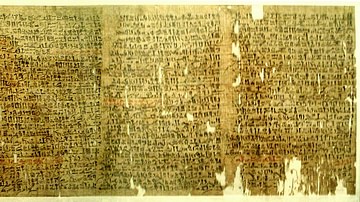
The Westcar Papyrus, dated to the Second Intermediate Period of Egypt (1782 - c.1570 BCE), but most likely written during the Middle Kingdom (2040-1782 BCE), contains some of the most interesting tales from ancient Egypt. The papyrus takes...
Image
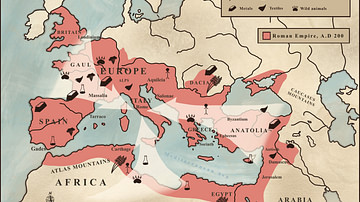
Trade in the Roman Empire Map (c. 200 CE)
This map shows the major sources of trade goods in the Roman Empire, circa 200 CE. The map shows the sources of the following trade goods: grain, olive oil, slaves, wine, metals, textiles and wild animals.
Image
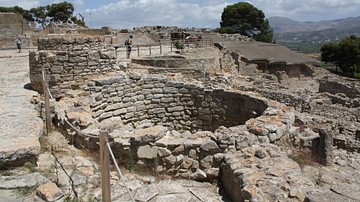
Silo, Phaistos, Crete
The minoan settlement of Phaistos archaeological site, Crete (2000-1400 BCE). A silo for grain storage.

Definition
Commodus
Commodus was Roman emperor from 180 to 192 CE. With the death of Roman Emperor Marcus Aurelius in March of 180 CE, the long reign of the five good emperors came to an end and with it so did the Pax Romana (the Roman Peace). Those emperors...

Definition
Aedile
The aedile was an official of the Roman Republic who maintained Roman roads, supervised the grain and water supply, and provided the city's citizens with games among other duties. Initially, they were plebeian and elected annually by the...

Article
Trade in Ancient Egypt
Trade has always been a vital aspect of any civilization whether at the local or international level. However many goods one has, whether as an individual, a community, or a country, there will always be something one lacks and will need...

Article
The Mesopotamian Pantheon
The gods of the Mesopotamian region were not uniform in name, power, provenance or status in the hierarchy. Mesopotamian culture varied from region to region and, because of this, Marduk should not be regarded as King of the Gods in the same...

Article
Roman Expeditions in Sub-Saharan Africa
Sub-Saharan Africa was explored by Roman expeditions between 19 BCE - 90 CE, most likely in an effort to locate the sources of valuable trade goods and establish routes to bring them to the seaports on the coast of North Africa, thereby minimizing...
