
Search
Remove Ads
Advertisement

 This answer was generated by
 Search Results

Article
How Germany Lost World War I
Germany started the First World War (1914-18) with the belief its armed forces could win a quick and decisive victory over France and then Russia. The reality turned out to be much more complicated as more countries...

Article
The 1918 Armistice with Germany - Allied Victory on WWI's Western Front
The armistice that ended the First World War (1914-18) on the Western Front was signed between Germany and the Allies on 11 November 1918. The guns fell silent at 11:00 a.m. that day...

Article
Allied Bombing of Germany
The Allied strategic bombing of Germany during World War II (1939-45) involved British and U.S. bomber planes attacking industrial cities, factories, railways, airfields, and dams. Over 600,000 civilians died as a consequence...
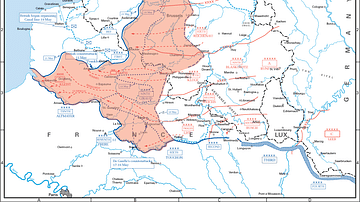
Image
Germany's Western Attack, May 1940
A map showing the German advances through Belgium, the Netherlands, and France which isolated the British Expeditionary Force and necessitated the Dunkirk evacuation of May-June 1940. (United States Military Academy...

Article
A Visitor's Guide to Rome's Frontier in Germany
In the 2nd century CE, the Roman Empire stretched from Scotland in northern Europe to the deserts of southern Egypt, encompassing the entirety of the Mediterranean basin. Beyond that lay its borders. Where...

Definition
Anschluss
The Anschluss ('fusion') of 12 March 1938 was the annexation and formal union of Austria with Germany. Adolf Hitler (1889-1945), the Nazi leader of Germany, dreamed of an empire which enclosed all German speakers, his 'Greater Germany'...

Article
The Causes of WWII
The origins of the Second World War (1939-45) may be traced back to the harsh peace settlement of the First World War (1914-18) and the economic crisis of the 1930s, while more immediate causes were the aggressive invasions...

Definition
Treaty of Versailles
The Treaty of Versailles, signed in June 1919, was an agreement between the victors of the First World War (1914-18) which redivided parts of Europe and imposed reparations, armament limitations, and total blame for the war...

Definition
Nazi-Soviet Pact
The Nazi-Soviet Pact, also called the Molotov-Ribbentrop Pact after the respective foreign ministers of the USSR and Germany, was a non-aggression agreement signed in August 1939. The pact allowed the leader of Nazi Germany Adolf...

Image
The Rise of Nazi Germany, 1919 - 1939
This infographic illustrates the rise of Nazi Germany in the aftermath of the First World War (1914-18), when the Treaty of Versailles (1919) imposed harsh reparations and territorial losses on Germany, leading...
