
Search
Remove Ads
Advertisement
Search Results

Definition
Blitzkrieg - The Lightning War Tactic of Combined Arms
Blitzkrieg ('lightning war') is a military tactic combining air and land forces deployed at speed against the enemy's weaker points while the rear lines are simultaneously disrupted by acts of sabotage...

Definition
Hitler Youth
The Hitler Youth (Hitlerjugend or HJ), named after the leader of the German Nazi Party Adolf Hitler (1889-1945), was designed to indoctrinate 14-18 year-old boys into the party's way of thinking. Its activities promoted physical...

Article
Key German Weapons of World War I
Superior weapons can win wars, and during the First World War (1914-18) all sides attempted to gain an advantage over the enemy by producing more and more destructive devices that could be used effectively on land...

Article
The Zeppelin Bombing Raids of WWI
Zeppelin airships were used by Germany to attack its enemies on all fronts during the First World War (1914-18). Bombing raids, usually conducted at night, targeted key infrastructure like railways and docks, dropping...
Article
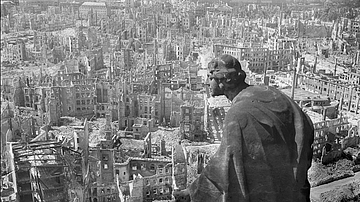
The Bombing of Dresden in 1945
The bomber raid on Dresden was a controversial and highly destructive combined operation by Royal Air Force Lancaster bombers and United States Air Force B-17 Flying Fortress bombers on 13, 14, and 15 February and...

Article
The Schweinfurt-Regensburg Raids - The US Bombing of Germany's Ball-Bearing Factories
The Schweinfurt-Regensburg raids in Germany were a series of attacks by B-17 Flying Fortress and B-24 Liberator bombers of the United States Air Force in August and October...

Definition
Yalta Conference - Roosevelt, Churchill & Stalin Create a New World Order
The Yalta Conference of 4-11 February 1945 was a meeting of the 'Big Three' Allied leaders: President of the United States Franklin D. Roosevelt, British Prime Minister Winston Churchill...

Definition
Casablanca Conference - The Call for an Axis Unconditional Surrender in WWII
The Casablanca Conference of January 1943, code-named Symbol, was a meeting between US President Franklin D. Roosevelt and British Prime Minister Winston Churchill to agree on how...

Definition
Night of the Long Knives
The Night of the Long Knives (aka Blood Purge or Röhm-Putsch) of 30 June 1934 was a purge of the Nazi Sturmabteilung (SA) paramilitary group which continued through 1 and 2 July. Adolf Hitler (1889-1945), wary of the growing...

Article
What Were the Consequences of WWII?
The consequences of the Second World War (1939-45) were many and varied. Nazi Germany, Fascist Italy, and military-dominated Japan were all defeated. Many occupied countries were liberated and regained their freedom...
