
Search
Remove Ads
Advertisement
Search Results

Image
Abusina Roman Limes Fort, Germany
Abusina was a Roman military camp of the Roman province of Rhaetia. It is located at Eining on the Danube around 30 kilometres (984 ft) south-west of Regensburg, along the Upper Germanic-Rhaetian Limes. Originally...
Image
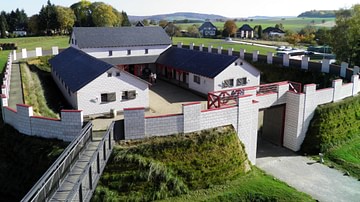
Reconstructed Roman Fortlet in Pohl, Germany
The Limes Fortlet in Pohl (German Limeskastell Pohl) is an authentic replica of a small limes fort with a watchtower. It is designed as an open-air museum and gives a vivid and plausible impression of life...

Definition
Moroccan Crises - German v. French Imperialism
The Moroccan Crises were two international incidents, the first in 1905-6 and the second in 1911, when Imperial Germany, eager to expand its empire, threatened France's presence in Morocco. France's position...

Article
The Anglo-German Arms Race - Riding the Waves to WWI
The pre-First World War arms race between Britain and Germany was fuelled by Britain's desire to protect its empire, Germany's desire to build an empire, and a general atmosphere of suspicion amongst...

Article
Hitler's Occupation of Czechoslovakia
Throughout 1938, Adolf Hitler (1889-1945), the leader of Nazi Germany, threatened to occupy the Sudetenland region of Czechoslovakia. The excuse presented was that Sudeten Germans were being repressed but Hitler...

Video
US & Germany Clash at Kasserine Pass | Biggest Battles of WWII | History
In November 1943, the Axis forces in Tunisia smashed into the US Army at the Battle of Kasserine Pass, the first major engagement between the US and Germany in WWII. Learn more, in...

Definition
Munich Agreement
The Munich Agreement, signed on 30 September 1938 at the Munich Conference attended by the leaders of Britain, France, Italy, and Germany, handed over the Sudetenland of Czechoslovakia to Germany in the hope that this act of appeasement...

Article
The Invasion of Poland in 1939
The leader of Nazi Germany Adolf Hitler (1889-1945) ordered the invasion of Poland on 1 September 1939. Hitler's refusal to withdraw brought a declaration of war from Britain and France on 3 September, and so began...

Definition
Locarno Pact - The Treaty that Won the Nobel Peace Prize
The Locarno Pact, actually a group of seven treaties (hence its other name: the Locarno Treaties), was signed on 1 December 1925 with the aim that peace continued in Europe despite the German government's...

Article
Why Did Hitler Hate Jewish People?
The leader of Nazi Germany Adolf Hitler (1889-1945) identified Jewish people as enemies of the state, presenting them through relentless propaganda as responsible for Germany's economic and cultural decline. Basing...
