
Search
Did you mean: Giants?
Remove Ads
Advertisement
Search Results

Article
Battle of Friedland
The Battle of Friedland (14 June 1807) was a decisive battle of the Napoleonic Wars (1803-1815), fought by the armies of the French and Russian empires. A major French victory, Friedland caused the Russians to sue for peace, resulting in...

Article
Observatories in the Scientific Revolution
The foundation of observatories during the Scientific Revolution (1500-1700) followed a process of evolution from entirely independent observatories operated by a single astronomer to private observatories which received state or private...

Article
Clocks in the Scientific Revolution
Keeping good time proved an elusive objective for centuries, and it was only in the second half of the 17th century, during the Scientific Revolution (1500-1700), that clocks were made which lost seconds rather than minutes each day. The...

Article
Why Poland-Lithuania Disappeared
The Polish-Lithuanian Republic (1569-1795) was one of the largest and most populous states in Early Modern Europe, yet in 1795, its last remnants were partitioned between Austria, Prussia, and Russia. Here we take a look at the reasons why...
Image
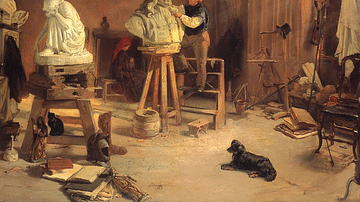
Freitag Sculpting Hevelius
An 1870 oil-on-canvas painting by Wilhelm August Stryowski showing Rudolf Freitag sculpting a bust of the Polish astronomer Johannes Hevelius (1611-1687). (National Museum, Gdańsk)

Image
Johannes Hevelius by Schultz
A 1677 portrait by Daniel Schultz of Johannes Hevelius (1611-1687), the Polish astronomer. (Library of Polish Academy of Sciences, Gdańsk)
