
Search
Remove Ads
Advertisement
Search Results

Image
Gandhara Bodhisattva
Bodhisattva Maitreya Kushan period 2nd-3rd century CE from the ancient region of Gandhara, India/Afghanistan. (Asian Art Museum, San Francisco).

Definition
Siddhartha Gautama
Siddhartha Gautama (better known as the Buddha, l. c. 563 - c. 483 BCE) was, according to legend, a Hindu prince who renounced his position and wealth to seek enlightenment as a spiritual ascetic, attained his goal and, in preaching his path...

Image
Bodhisattva Head, Gandhara
Head of a Bodhisattva, Pakistan or Afghanistan Gandharan region 4th-6th century CE. Stucco with traces of pigment. (The Art Institute of Chicago).

Definition
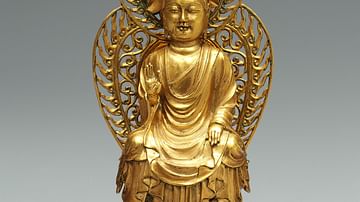
Ancient Korean Sculpture
The sculpture of ancient Korea was dominated by Buddhist themes such as figurines and monumental statues of the Buddha and his followers, and large bronze bells for temples. Gilded-bronze was the most common material used by Korean sculptors...
Article
Buddhism in Ancient Korea
Buddhism, in Korean Bulgyo, was introduced by monks who visited and studied in China and then brought back various Buddhist sects during the Three Kingdoms period. It became the official state religion in all Three Kingdoms and subsequent...

Article
Heraclitus: Life Is Flux
Heraclitus of Ephesus (l. c. 500 BCE) famously claimed that “life is flux” and, although he seems to have thought this observation would be clear to all, people have continued to resist change from his time to the present day. Heraclitus...

Video
Gandhara - The Quest for Enlightenment (Part 1)
Glimpses of Gandhara Buddhist Heritage Pakistan is the custodian of some of the most sacred Buddhist heritage sites in the world dating back to the 3rd century BC. Pakistan’s Gandhara region offers a unique opportunity for pilgrims and visitors...
Image
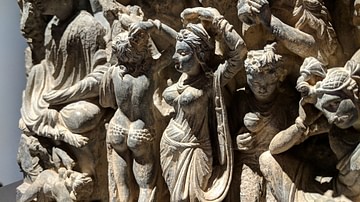
Mara's Daughters Tempt the Buddha
The temptation of the Buddha by Mara's daughters. Slate, Gandhara region, Pakistan, 2nd to 4th century CE. Exhibited at Museum Rietberg, Zurich, Switzerland.

Definition
Dhammapada
Tipitaka (Sansktrit: Tripitaka), the Buddhist canon, consists of three pitaka (Tri means three and Pitaka refers to boxes), namely Vinaya or Monastic regimen, Sutta (Sanskrit: Sutra) or Discourses and Abhidhamma (Sanskrit: Abhidharma) or...
Definition
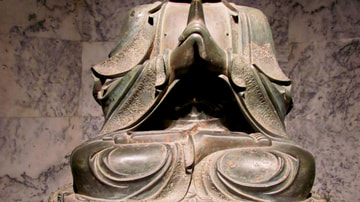
Esoteric Buddhism
Esoteric Buddhism is the mystical interpretation and practice of the belief system founded by the Buddha (known as Sakyamuni Buddha, l. c. 563 - c. 483 BCE). It is known by several names and is characterized by a personal relationship with...
