
Search
Remove Ads
Advertisement
Search Results
Image
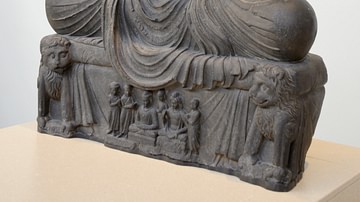
Statue of Guatama Buddha from Gandhara
Buddha was a Hindu prince (c. 500 BCE) who renounced the world to become a wondering ascetic. This hornblende schist rock statue depicts Buddha cross-legged in meditation. From the Gandhara school, India, 200-300 CE. (National Museum of Scotland...

Image
Seated Buddha from Gandhara
This Seated Buddha was found in Gandhara, Pakistan (100-300 CE).
This image was taken at the National Museum of Australia in the travelling exhibition A History of the World in 100 (and 1) Objects.
Article
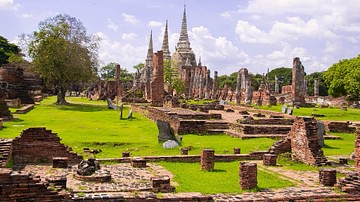
Ayutthaya: Venice of the East
The royal city of Ayutthaya (ah-you-tah-ya) was a small kingdom in Siam (modern Thailand), and it was an unrivalled commercial and maritime power from 1350-1767 CE. Ayutthaya became the second capital of Siam in 1438 CE when it absorbed the...
Definition
Four Noble Truths
The Four Noble Truths are the foundational tenets of Buddhism, which spark awareness of suffering as the nature of existence, its cause, and how to live without it. The truths are understood as the realization which led to the enlightenment...
Image
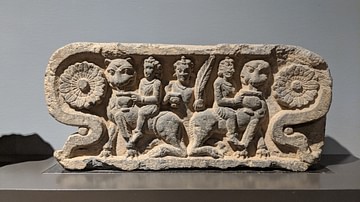
Gandhara Lions & Genii Relief
Lions and Genii (Djinns), Gandhara region, India, 5th century CE. Exhibited at Museum Rietberg, Zurich, Switzerland.

Image
Siddhartha's Secret Escape, Gandhara Relief
The prince Siddhartha secretly leaves the palace of his father. Not to wake the sleeping inhabitants of the palace, yakshas lift his horse on its hooves and carry it above the ground. Gandhara region, Pakistan, 3rd / 4th century CE...

Article
Ten Great Stupas from Around the World
A stupa is a reliquary containing the remains (relics) of an individual associated with great spiritual power and insight, most often (since the 3rd century BCE) with the Buddha (l. c. 563 - c. 483 BCE). The form, a hemisphere topped by a...
Definition
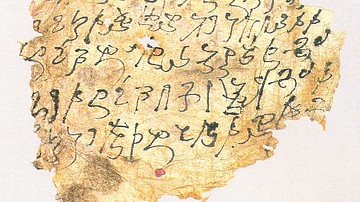
Kharosthi Script
The Kharosthi script (also known as 'Indo-Bactrian' script) was a writing system originally developed in present-day northern Pakistan, sometime between the 4th and 3rd century BCE. Kharosthi was employed to represent a form of Prakrit (Middle...

Definition
White Huns (Hephthalites)
The White Huns were a race of largely nomadic peoples who were a part of the Hunnic tribes of Central Asia. They ruled over an expansive area stretching from the Central Asian lands all the way to the Western Indian Subcontinent. Although...

Interview
Interview: Bejeweled Sri Lanka
The first comprehensive survey of Sri Lankan art organized by an American museum, The Jeweled Isle: Art from Sri Lanka, on show now at the LACMA in Los Angeles, California, presents some 250 works addressing nearly two millennia of Sri Lankan...
