
Search
Remove Ads
Advertisement
Search Results

Definition
Todaiji
Todaiji is an ancient temple complex in Nara, Japan. Founded in 738 CE and officially opened in 752 CE when Nara was the capital, the temple is the headquarters of the Buddhist Kegon sect. The temple has a 500-ton sculpture of the Buddha...

Definition
Ajanta
Approximately 67 miles (107 km) to the north of Aurangabad in the Indhyadri range of Western Ghats lie the caves of Ajanta. The 30 caves, famous for their early Buddhist temple architecture and many delicately drawn murals, are located in...
Image
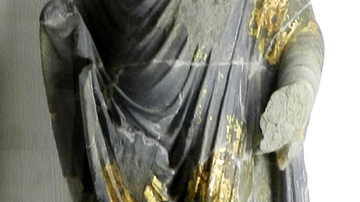
Gilded Buddha Statue
A sculpture of the Buddha with some of the original gold leaf still intact. This shows the extravagance with which these statues were decorated. 2nd-3rd century CE. (Taxila Museum, Punjab, Pakistan)
Image
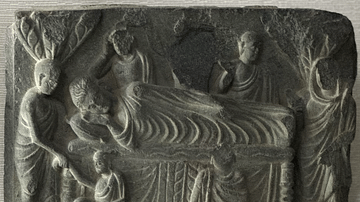
Death of Buddha
Death of Buddha, Thareli, Gandhara, 3rd-4th century CE.
Taxila Museum, Pakistan.
Image
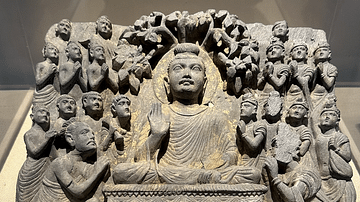
Buddha in the Preaching Pose
Buddha in the preaching pose, Gandhara, 2nd-3rd century.
Islamabad Museum, Pakistan.

Image
Worship of Buddha's Bowl
A sculpture from Gandhara depicting the worship of Buddha's bowl, 2nd-5th century CE.
Islamabad Museum, Pakistan.
Definition
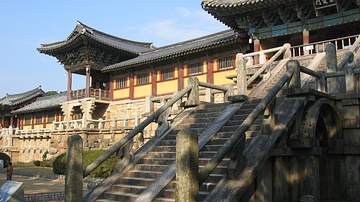
Bulguksa Temple
The Bulguksa Temple (aka Pulguk-sa Temple or 'Temple of the Buddha Land') was built in the 8th century CE on the wooded slopes of Mt. Tohamsan at the ancient Silla capital of Geumseong (modern Gyeongju, South Korea). The Buddhist temple...
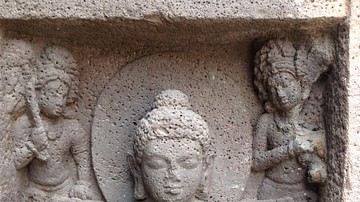
Image
Seated Buddha Figure Displaying Dharmachakra Mudra
Here, the figure seated in the lotus position features two important details: first, a halo, indicating that Prince Siddhartha has attained Enlightenment and so has become the "Buddha", or the Enlightened One, and second, the Dharmachakra...

Definition
Ashoka the Great
Ashoka the Great (r. 268-232 BCE) was the third king of the Mauryan Empire (322-185 BCE) best known for his renunciation of war, development of the concept of dhamma (pious social conduct), and promotion of Buddhism as well as his effective...

Definition
Bimbisara
Bimbisara (c. 545/544 BCE - c. 493/492 BCE) was a king of the Magadha Kingdom who is credited with establishing imperial dominance in the Indian subcontinent. Son of a minor king called Bhattiya, he belonged to the Haryanka Dynasty, which...
