
Search
Remove Ads
Advertisement
Search Results

Definition
Charles V, Holy Roman Emperor
Charles V, Holy Roman Emperor (24 February 1500 to 21 September 1558) reigned from 1519 until his abdication in 1556 and was one of the most powerful rulers in the history of the Habsburg dynasty. Through a series of...

Definition
War of the Third Coalition
The War of the Third Coalition (1805-1806) was a major European conflict during the Napoleonic Wars (1803-1815). It was fought by an alliance of nations that included the United Kingdom, Russia, Austria, Sweden, Naples...

Definition
Ignatius of Loyola
Ignatius of Loyola (l. 1491-1556) was a Basque soldier who became a Catholic priest and theologian after a mystical experience convinced him he was called to the service of Christ. He founded the Society of Jesus (Jesuits) to...

Definition
War of the Fifth Coalition
The War of the Fifth Coalition (1809) was a major conflict of the Napoleonic Wars (1803-1815) that was fought primarily in Central Europe between the First French Empire and its client states against the Austrian Empire...

Definition
Mary of Guise
Mary of Guise (aka Marie de Lorraine, 1515-1560) was a French noblewoman who became the second wife of James V of Scotland (r. 1513-1542). With the premature death of her husband, her daughter Mary, Queen of Scots (r. 1542-1567...

Definition
Giovanni Bellini
Giovanni Bellini (c. 1430-1516 CE) was an Italian Renaissance artist best known for his innovative use of colour, interest in light, and emphasis on brushwork. Today, Giovanni is recognised as the most innovative and influential...
Article
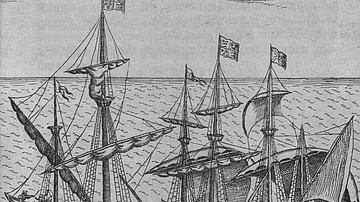
The Sea Dogs - Queen Elizabeth's Privateers
The sea dogs, as they were disparagingly called by the Spanish authorities, were privateers who, with the consent and sometimes financial support of Elizabeth I of England (r. 1558-1603 CE), attacked and...

Article
Christianity in Japan
Christianity arrived in Japan in 1549 when Jesuits first set foot in Kagoshima. Initial attempts to spread the religion were met with confusion; however, through employing various methods, they began to see success. However...

Article
Mayflower Passengers & Crew
The 102 Mayflower passengers were a diverse group made up of religious separatists (later known as pilgrims) and others referred to by the pilgrims as Strangers (people who did not share their faith). The ship also had...

Article
Treasure Ports of the Spanish Main
The treasure ports of the Spanish Main such as Cartagena, Portobelo, Panama, and Veracruz were used to collect the riches the Spanish Empire had extracted from the Americas, ready for transport in the two annual...
