
Search
Did you mean: Ur?
Remove Ads
Advertisement
Search Results

Definition
Neith
Neith (aka Net, Neit or Nit) and is one of the oldest deities of ancient Egypt who was worshipped early in the Pre-Dynastic Period (c. 6000 - 3150 BCE) and whose veneration continued through the Ptolemaic Dynasty (323 - 30 BCE), the last...

Definition
Arminius
The Cherusci noble Arminius (c. 18 BCE - 19 CE) led the resistance to Roman conquest of Germania during the years 9-16 CE. Likely raised as a child hostage in Rome, Arminius gained command of a German auxiliary cohort in the Roman army...

Definition
Periander
Periander was the second tyrant of Corinth (d. c. 587 BCE); Diogenes Laertius only mentions that he was eighty when he died, meaning that he was probably born c. 667 BCE. His father Cypselus (r. 657-627 BCE), from whom the short-lived...

Definition
God's Wife of Amun
The position of God's Wife of Amun was one of the most politically powerful and spiritually significant in later Egyptian history. Elevated from a figurehead in the New Kingdom (c.1570-1069 BCE), the God's Wife of Amun would...

Definition
Ancient Nara
Nara, located around 30 km south of modern Kyoto, was the capital of ancient Japan between 710 and 784 CE. It gave its name to the Nara Period (710-794 CE), although the name during the 8th century CE was Heijokyo. Modelled on the...

Definition
Excalibur
Excalibur is the sword of King Arthur in Sir Thomas Malory's iconic work Le Morte D'Arthur published in in 1485 CE. The sword was originally introduced in Geoffrey of Monmouth's History of the Kings of Britain (1136 CE) as Caliburnus...
Definition
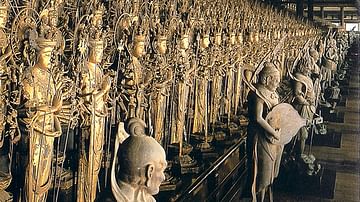
Sanjusangendo
Sanjusangendo is a Buddhist temple which is part of the Rengeo-in monastery in Kyoto, Japan. Founded in 1164 CE, the temple is famous for its impressive dimensions and the 1,001 golden Buddha figures and 28 guardian statues which...

Definition
Leo III
Leo III was emperor of the Byzantine Empire from 717 to 741 CE. He founded the Isaurian dynasty which ruled until 802 CE. The emperor was a talented administrator, and he revamped the empire's political apparatus and legal code. Leo's...

Definition
William the Conqueror
William the Conqueror (c. 1027-1087), also known as William, Duke of Normandy, led the Norman Conquest of England in 1066 when he defeated and killed his rival Harold Godwinson at the Battle of Hastings. Crowned King William...

Definition
Edward the Elder
Edward the Elder (r. 899-924) was the son of Alfred the Great (r. 871-899) and the King of the Anglo-Saxons in the early 10th century. He is known for his military victories over the Vikings of East Anglia and the East Midlands...
