
Search
Remove Ads
Advertisement
Search Results

Definition
Edward Elgar
Edward Elgar (1857-1934) was an English composer best known for his orchestral music and oratorios. Amongst Elgar's most-loved works are his Pomp and Circumstance marches which inspired the choral Land of Hope and Glory, a rousing...
Definition
Kappa
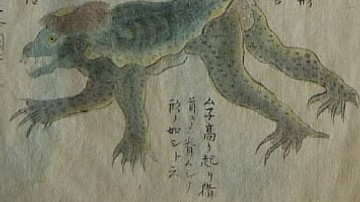
A kappa is a Japanese mythological water sprite or, literally, "river child" (河童). One of the more popularly known yōkai (Japanese mythological creature) in Japan, kappa are generally green or yellow, have a tortoise-like shell on their...

Definition
Urbanization
Urbanization is the process by which rural communities grow to form cities, or urban centers, and, by extension, the growth and expansion of those cities. Urbanization began in ancient Mesopotamia in the Uruk Period (4300-3100 BCE...

Definition
Satyr
Satyrs (aka silens) are figures from Greek mythology who were followers of the god of wine Dionysos. Satyrs were often guilty of excessive sexual desires and overindulgence of wine. Men with a horse's tail and ears or men with goat legs...

Definition
Galatia
Galatia was a region in north-central Anatolia (modern-day Turkey) settled by the Celtic Gauls c. 278-277 BCE. The name comes from the Greek for "Gaul" which was repeated by Latin writers as Galli. The Celts were offered the region by...

Definition
Sophocles
Sophocles of Kolōnos (c. 496 - c. 406 BCE) was one of the most famous and celebrated writers of tragedy plays in ancient Greece and his surviving works, written throughout the 5th century BCE, include such classics as Oedipus Rex...

Definition
Medea (Play)
The tragedy Medea was written in 431 BCE by Euripides (c. 484 – 407 BCE). Euripides authored at least 90 plays of which 19 have survived intact. As with the plays by Sophocles and Aeschylus, the audience was already well aware of...

Definition
Malia
Located near a fertile plain in northern Crete and with its own harbour, Malia was one of the major settlements and palaces of the Minoan civilization. Inhabited since Neolithic times (6000 BCE) and with the first evidence of monumental...

Definition
Horus
Horus is the name of a sky god in ancient Egyptian mythology which designates primarily two deities: Horus the Elder (or Horus the Great), the last born of the first five original gods, and Horus the Younger, the son of Osiris and Isis...

Definition
Euripides
Euripides (c. 484-407 BCE) was one of the greatest authors of Greek tragedy. In 5th century BCE Athens his classic works such as Medeia cemented his reputation for clever dialogues, fine choral lyrics and a gritty realism in both his...
