
Search
Did you mean: Hestia?
Remove Ads
Advertisement
Search Results

Article
Queen Hatshepsut: Daughter of Amun, Pharaoh of Egypt
Hatshepsut, whose name means "Foremost of Noble Women" or "First Among Noble Women" (royal name, Ma'at-ka-re, translated as "spirit of harmony and truth") was the fifth ruler of the 18th Dynasty (r...

Article
The Legend of Romulus
Despite allegedly founding Rome and being hailed a hero, Romulus’ legacy is complex and his biography is even disturbing at times. He was supposedly guilty of committing many terrible deeds that still make readers recoil...

Article
Buddhism in Ancient Korea
Buddhism, in Korean Bulgyo, was introduced by monks who visited and studied in China and then brought back various Buddhist sects during the Three Kingdoms period. It became the official state religion in all Three Kingdoms...
Article
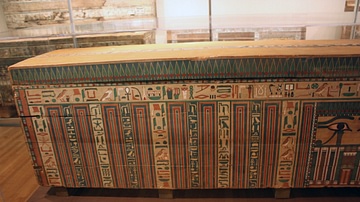
The Coffin Texts
The Coffin Texts (c. 2134-2040 BCE) are 1,185 spells, incantations, and other forms of religious writing inscribed on coffins to help the deceased navigate the afterlife. They include the text known as the Book of Two Ways which...

Article
Games, Sports & Recreation in Ancient Egypt
Although the ancient Egyptians are often depicted as death-obsessed and dour, they actually had a great appreciation for life and their culture reflected their belief in existence as an eternal journey imbued...

Article
Colchis & Iberia in Antiquity
Colchis (western Georgia) and Kartli/Iberia (eastern and southern Georgia) were important regions in the Caucasus area of Eurasia from the Bronze Age of the 15th century BCE. Prospering through agriculture and trade...

Article
Holidays in the Elizabethan Era
During the Elizabethan Era (1558-1603 CE), people of all classes greatly looked forward to the many holidays and festivals on offer throughout the year. The vast majority of public holidays were also religious commemorations...

Article
Ruth & Naomi
The story of Ruth and Naomi is found in the book of Ruth in the Jewish Scriptures. The Scriptures are traditionally divided into three sections: Torah (the first five books assigned to Moses), the Prophets (Nevi’im), and Writings...

Article
Plato's Lie In The Soul
Plato's Lie in the Soul (or the True Lie) is a concept appearing in Republic, Book II, 382a-382d, defined as "being deceived in that which is the truest and highest part of or about the truest and highest matters" or, in...

Article
Enlil in the E-kur - Praising God in Ancient Mesopotamia
Enlil in the E-Kur (circa 2000 BCE) is a Sumerian hymn praising the sky god Enlil, his temple/ziggurat at Nippur, and his consort Ninlil, depicting all three in glowing terms and Enlil as a creator...
