
Search
Did you mean: Hestia?
Remove Ads
Advertisement
Search Results
Article
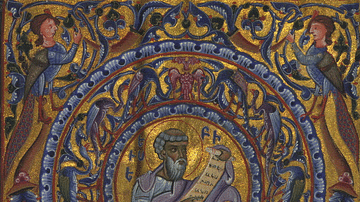
Eusebius on Christianity
Eusebius Pamphili (aka Eusebius of Caesarea, 260-340 CE) was a Christian historian, exegete, and polemicist. He became the bishop of Caesarea Maritima in 314 CE and served as court bishop during the reign of Constantine...

Article
Origins of Christian Antisemitism in the Gospels
Antisemitism is a modern term that describes prejudice and hostility to Jews and Judaism. The term is derived from the later social scientific categorization of the subfamily of the Afro-Asiatic languages...

Article
The Mask of Xiuhtecuhtli
The striking turquoise mask now in the British Museum in London is thought to represent Xiuhtecuhtli, the Aztec god of fire, and dates to the final century of the Aztec empire, c. 1400-1521 CE. It is made from hundreds...

Article
Color in Ancient Egypt
The ancient Egyptians had a great appreciation for life which is clearly depicted through their art. Images of people enjoying themselves - whether in this life or the next - are as plentiful as those most often seen of the...

Article
The Origin & History of the BCE/CE Dating System
The BCE/CE dating system was first used in the 17th century and has been used since in scholarly publications read by people of all faiths and cultures in an effort to be inclusive. This system is also...

Article
Caesar As Dictator: His Impact on the City of Rome
Gaius Julius Caesar (100-44 BCE) first assumed the role of dictator in 49 BCE, however, once he had secured his election as consul for the following year, he resigned after 11 days. After defeating...
Article
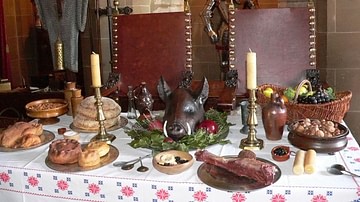
Food in an English Medieval Castle
If one was looking to enjoy a fine meal in the medieval world then the best place to find a handsomely laid dinner table was in the local castle. There, in the magnificent Great Hall, feasts were regularly served...

Article
Cats in the Middle Ages
Cats in the Middle Ages were generally disapproved of, regarded as, at best, useful pests and, at worst, agents of Satan, owing to the medieval Church and its association of the cat with evil. Prior to the widespread acceptance...

Article
Wine Culture in the Hellenistic Mediterranean
The culture of drinking wine was enjoyed throughout the Mediterranean world, and what is true now was true in antiquity, too: wine is always good business. The Hellenistic Period (c. 335-30 BCE), between...

Article
Constantine’s Conversion to Christianity
Constantine I (Flavius Valerius Constantinus) was Roman emperor from 306-337 CE and is known to history as Constantine the Great for his conversion to Christianity in 312 CE and his subsequent Christianization...
