
Search
Remove Ads
Advertisement
Search Results
Definition
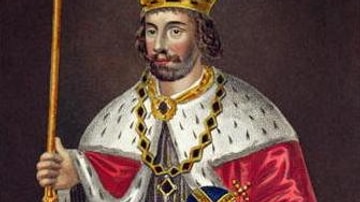
Edward II of England
Edward II of England reigned as king from 1307 to 1327 CE. Succeeding his father Edward I of England (r. 1272-1307 CE), his reign saw a disastrous defeat to the Scots at Bannockburn in June 1314 CE, and the king's lack of...

Definition
Christopher Marlowe - Poet, Playwright, Spy
Christopher Marlowe (1564-1593), or Kit Marlowe, was a poet and playwright of the English Renaissance who wrote during the Elizabethan Era (1558-1603). His mastery of the blank verse – unrhymed iambic pentameter...

Definition
Galileo Galilei
Galileo Galilei (1564-1642) was an Italian mathematician, physicist, astronomer, and natural philosopher. He created a superior telescope with which he made new observations of the night sky, notably that the surface of the Moon...

Definition
Seven Years' War - The 18th-Century World War
The Seven Years' War (1756-1763) was a global conflict fought between the great powers of Europe in the mid-18th century. The culmination of several decades of conflict, it was caused both by colonial rivalries...

Definition
New Model Army
The New Model Army was created in February 1645 by the Parliamentarians during the English Civil Wars (1642-1651) that turned England from a monarchy to a republic. It was a professional army in terms of its personnel, training...

Definition
Paul Gauguin
Eugène Henri Paul Gauguin (1848-1903) was a French neo-impressionist painter whose vivid paintings with their flat, bold colours and use of mystical and ambiguous symbols revolutionised art. Never quite gaining success in his own...

Definition
Anglo-Mysore Wars
The Four Anglo-Mysore Wars (1767-1799) were fought between the British East India Company (EIC) and the state of Mysore. Haidar Ali and his son Tipu Sultan, the "Tiger of Mysore", were relentless foes to British expansion in...

Definition
Second Continental Congress
The Second Continental Congress was the body of delegates that governed the Thirteen Colonies and, later, the United States during the American Revolutionary War. Between its first session in May 1775 and its disbandment...

Definition
Night of the Long Knives
The Night of the Long Knives (aka Blood Purge or Röhm-Putsch) of 30 June 1934 was a purge of the Nazi Sturmabteilung (SA) paramilitary group which continued through 1 and 2 July. Adolf Hitler (1889-1945), wary of the growing...

Definition
Frederick Douglass - American Visionary
Frederick Douglass (circa 1818-1895) was an abolitionist orator, minister, writer, editor, reformer, and statesman, who had been born a slave in Maryland, escaped to New York at around the age of 20, and became...
