
Search
Remove Ads
Advertisement
Search Results
Image
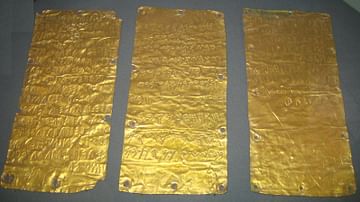
Etruscan & Phoenician Inscriptions
Gold sheet plaques from Pygri, the port of Etruscan Cerveteri. In both the Etruscan and Phoenician alphabet they describe the separation of a space dedicated in the temple there for Astarte. c. 500 BCE (Museo di Villa Giulia, Rome)

Image
Etruscan Bronze Mirror Showing Hercules
An Etruscan bronze mirror back showing the abduction of Miacuch by Hercules. 500-475 BCE. (British Museum, London)
Image
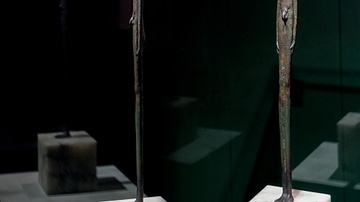
Etruscan 'Evening Shadow' Figure Sculpture
The Etruscan bronze figure sculpture of a young boy known as the Ombre della Sera or 'Evening Shadow'. 3rd century BCE. Height: 57 cm. (Museo Etrusco Guarnacci, Volterra, Italy)
Image
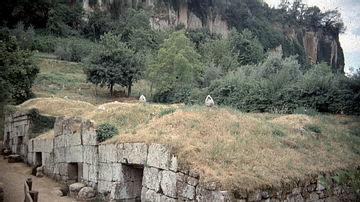
Etruscan Tombs, Volsinii
Etruscan tombs at Volsinii (Orvieto). 6th-5th century BCE. Many of the tombs have an inscription above the single doorway indicating the name of the principal occupant.
Image
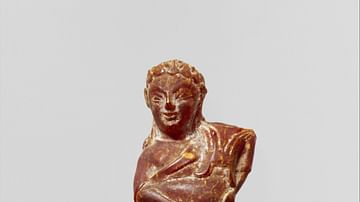
Etruscan Amber Figurine
A figurine of a woman holding a child. Amber, 5th century BCE, Etruscan. Height: 6.3 cm. (Metropolitan Museum of Art, New York)

Image
Etruscan Mother & Child
A bronze statue of an Etruscan mother and child in typical dress. 500-450 BCE.
Louvre Museum, Paris.
Image
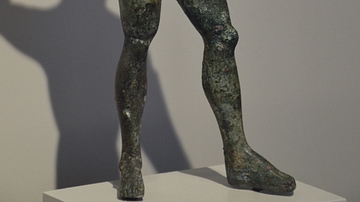
Etruscan Votive Statuette of Hercle
Etruscan votive bronze statuette of Hercle (Heracles), 4th - 2nd century BCE. (Altes Museum, Berlin)
Image
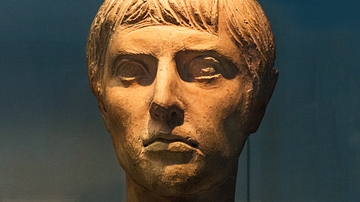
Etruscan Male Head
Etruscan male head from Latium. 3rd century BCE. (Antikensammlungen, Munich, Germany)

Definition
Volsinii
Volsinii (modern Orvieto), located in central Italy, was an important Etruscan town from the 8th century BCE when it was known by the name of Velzna. Representatives of the Etruscan League met annually at the site in the most important Etruscan...
Image
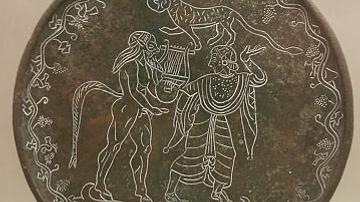
Etruscan Bronze Mirror with Nymph & Silenus
An Etruscan bronze mirror with an engraved scene depicting a nymph and Silenus. 500 BCE. (National Etruscan Museum, Rome)
