
Search
Remove Ads
Advertisement
Search Results
Image
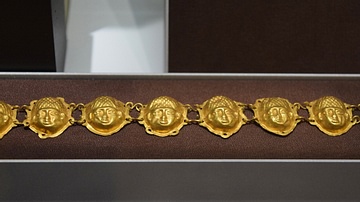
Etruscan Gold Jewelry
A strand of a gold Etruscan necklace, found in Italy, dating back to between 800 and 500 BCE.
Field Museum in Chicago, Illinois, USA.

Image
Etruscan Dancers
Limestone relief from an Etruscan tomb monument depicting dancers, 500-400 BCE. Probably from Chiusi, northern Italy. (Ashmolean Museum, Oxford)
Image
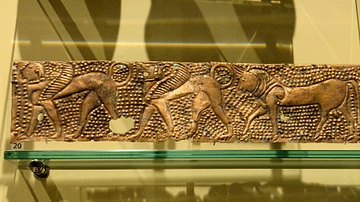
Etruscan Plaque of Griffins
With a lion's body and the wings and head of an eagle, the grffin encapsulates the majesty of both. At one time representing royalty, it gained the role of guardian. Griffins are used architecturally and can be found in domestic objects...
Image
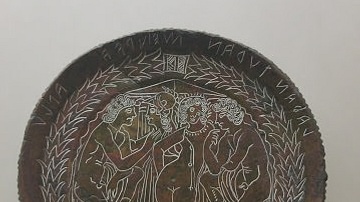
Etruscan Bronze Mirror
An Etruscan bronze mirror with an engraved scene depicting the gods Laran (Mars), Turan (Venus) Menrva (Minerva) and Aplu (Apollo) - all indicated by the inscription around the edge. 300-270 BCE. (National Etruscan Museum, Rome)

Definition
Volsinii
Volsinii (modern Orvieto), located in central Italy, was an important Etruscan town from the 8th century BCE when it was known by the name of Velzna. Representatives of the Etruscan League met annually at the site in the most important Etruscan...

Image
Etruscan Temple Model
A model of a 5th century BCE Etruscan temple. Temple A at Pyrgi, the port and sanctuary of Cerveteri/Cisra (Altes Museum, Berlin)

Image
Etruscan Inscription Plaque
A copper alloy plaque with an inscription in the Etruscan alphabet. The inscription reads from right to left and the top line is the name of the god Culsans, the second line is as yet undeciphered. 3rd - 2nd century BCE. (British Museum...

Image
Etruscan Votive Figure
A bronze figurine of a youth or priest offering a libation. 2nd century BCE. Etruscan-Latin. (British Museum, London)
Image
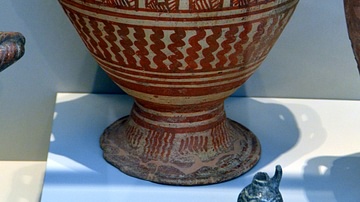
Etruscan Red on White Pottery Vessel
An Etruscan red on white slip pottery vessel from Vulci or Bisencio, c. 700 BCE. (Antikensammlung Berlin)
Image
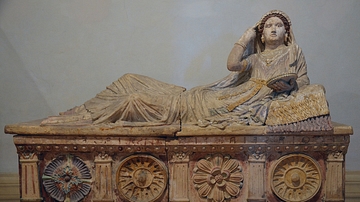
Etruscan Sarcophagus of Larthia Seianti
Etruscan Terracotta Sarcophagus of Larthia Seianti, found in Chiusi, 3rd century CE. (National Archaeological Museum of Florence)
