
Search
Remove Ads
Advertisement
Search Results
Image
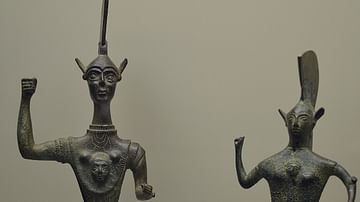
Etruscan Votive Statuettes of Menerva (Athena)
Two Etruscan votive bronze statuettes of Menerva the warrior (Athena) wearing a high-crested Attic helmet and a cuirass with the gorgoneion, 450-400 BCE. (National Etruscan Museum of Villa Giulia, Rome)

Image
Etruscan Maenad Roof Tile
A decorative end roof tile in the form of a maenad from the Etruscan Portonaccio Temple at Veii, central Italy. 510 BCE. (National Etruscan Museum of Villa Giulia, Rome)

Image
Etruscan Winged-horses, Tarquinia
A pair of terracotta winged-horses from the Temple of the Ara della Regina, Tarquinia. Etruscan, c. 350 BCE. (National Archaeological Museum, Tarquinia, Italy)
Image
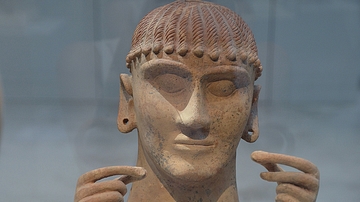
Etruscan Canopic Figure Urn
Etruscan terracotta canopic urn with a female head and articulated arms, from Chiusi (Italy), around 550-500 BCE. (Louvre Lens, France)

Image
Etruscan Circular House Model
A model of an early Etruscan hut in terracotta and bronze. 8th century BCE, from Vulci. (Museum of Art & History, Geneva)
Image
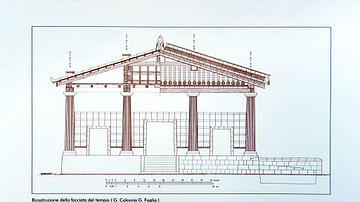
Etruscan Temple Diagram
A reconstruction of a typical 6th century BCE Etruscan temple such as the Portonaccio Temple at Veii, central Italy.
Image
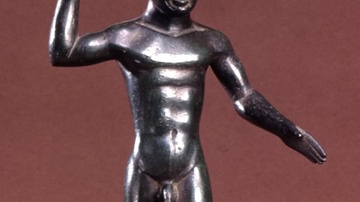
Etruscan Bronze Youth Statuette
A bronze votive statuette of a youth. Etruscan, Chiusi, 530-480 BCE. Height: 27.4 cms. (British Museum, London)
Image
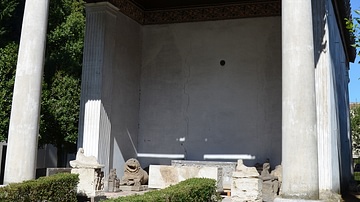
Etruscan Temple Reconstruction
A 19th century CE reconstruction of a typical Etruscan temple at the Villa Giulia Museum, Rome.
Definition
Veii
Veii (modern name: Isola Farnese, in Etruscan: Vei), was an important Etruscan town located near the west coast of central Italy. Lying just 16 km north of Rome, it was the most southerly of the major Etrurian settlements. The prosperity...
Image
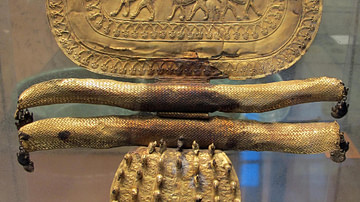
Etruscan Gold Fibula, Cerveteri
A gold fibula decorated with five lions (upper portion) and 50 ducks (lower portion) from the Etruscan Regoliini-Galassi Tomb at Cerveteri. 7th century BCE. (Museo Gregoriano Etrusco, Vatican Museums, Rome)
