
Search
Remove Ads
Advertisement
Search Results

Definition
The Pentecontaetia
The Pentecontaetia (Pentekontætia, πεντηκονταετία) or “the account of the fifty years” is a term first used by Thucydides to describe, in Book 1, Sections 89 to 117 (1.89-117) of his History of the Peloponnesian War, the period...

Definition
Roman Architecture
Roman architecture continued the legacy left by Greek architects and the established architectural orders, especially the Corinthian. The Romans were also innovators and they combined new construction techniques and materials...

Definition
Roman Baths
Roman baths were designed for bathing and relaxing and were a common feature of cities throughout the Roman empire. Baths included a wide diversity of rooms with different temperatures, as well as swimming pools and places to read...

Definition
Science
The term science comes from the Latin word scientia, meaning "knowledge". It can be defined as a systematic attempt to discover, by means of observation and reasoning, particular facts about the world, and to establish laws connecting...

Image
Roman Bridge, Mérida
The Roman bridge built over the Guadiana River at Emerita Augusta (Mérida, Spain) in the 1st century CE is the longest surviving bridge from ancient times, having once featured an estimated overall length of 755 m (2477.03...

Book Review
The Oxford Handbook of Engineering & Technology in the Classical World
Another heavyweight offering from the Oxford Handbook series which covers technology in the ancient Greek and Roman civilizations. As with other books in the series, each chapter is...

Article
The Inca Road System
The Inca road system formed a network known as the royal highway or qhapaq ñan, which became an invaluable part of the Inca empire. Roads facilitated the movement of armies, people, and goods across plains, deserts, and mountains...

Article
The Railways in the British Industrial Revolution
The railways were perhaps the most visible element of the Industrial Revolution for many. Trains powered by steam engines carried goods and people faster than ever before and reached new destinations...

Article
Ten Great Native American Mound Sites
The Native Americans of Pre-Colonial North America built thousands of mounds across the continent which served various purposes and sometimes reached heights over 100 feet. Many of the mound sites were thriving...
Article
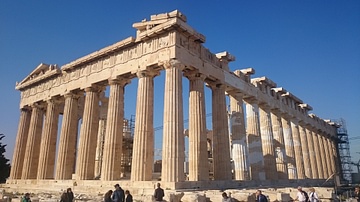
Greek World Heritage Sites
Greece, the 'cradle of western civilization', is home to a large number of spectacular sites from the ancient world, several of which have been placed on the UNESCO World Heritage List. These sites of great historical...
