
Search
Remove Ads
Advertisement
Search Results

Definition
Ninigi
Ninigi-no-Mikoto, or simply Ninigi, is the grandson of the supreme Shinto deity Amaterasu, the sun goddess. He is the son of Ama-no-Oshiho-mimi and, descending to earth as the first just ruler, he brought with him gifts from Amaterasu...

Definition
Taoism
Taoism (also known as Daoism) is a Chinese philosophy attributed to Lao Tzu (c. 500 BCE) which developed from the folk religion of the people primarily in the rural areas of China and became the official religion of the country under...

Article
Coronation of Napoleon I
The Coronation of Napoleon I as Emperor of the French took place on Sunday 2 December 1804, in the Notre-Dame de Paris cathedral. A sacred ceremony held to legitimize Napoleon's reign, the coronation signaled the birth...

Article
Reforms of Augustus
Emperor Augustus (27 BCE – 14 CE) accomplished much during his time on the Roman throne, far more than many of his successors. According to historian Mary Beard in her book SPQR, he transformed the structures of Roman Empire...
Definition
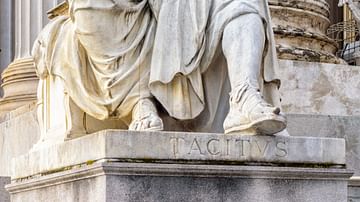
Tacitus
Publius Cornelius Tacitus (l. c. 56 - c. 118 CE) was a Roman historian, active throughout the reign of Trajan (r. 98-117 CE) and the early years of Hadrian (r. 117-138 CE). His best-known works are Histories and Annals, which cover the...

Definition
Pax Romana
The Pax Romana (Roman Peace) was a period of relative peace and stability across the Roman Empire which lasted for over 200 years, beginning with the reign of Augustus (27 BCE - 14 CE). The aim of Augustus and his successors was to...

Definition
Legio XXI Rapax
Legio XXI Rapax was a legion of the Roman army whose name name "Rapax" means "rapacious" or "greedy". It is not clear when the legion assumed this name; it may or may not be the same 21st legion Julius Caesar (100-44 BCE) formed...

Definition
Fourth Crusade
The Fourth Crusade (1202-1204 CE) was called by Pope Innocent III (r. 1198-1216 CE) to retake Jerusalem from its current Muslim overlords. However, in a bizarre combination of cock-ups, financial constraints, and Venetian trading...
Definition
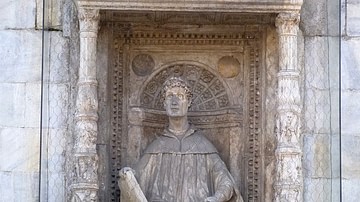
Pliny the Younger
Pliny the Younger (61-112 CE) was the nephew of Pliny the Elder (23-79 CE), the author of the 37-volume Natural History. He had a remarkable political career and gained a reputation as an excellent lawyer and orator, but he is...

Definition
Shapur I
Shapur I (r. 240-270 CE) is considered one of the greatest kings of the Sassanian Empire for expanding his realm, his policy of religious tolerance, building projects, and committing the Zoroastrian scriptures (Avesta) to writing. He...
