
Search
Search Results

Definition
Kamakura Period
The Kamakura Period or Kamakura Jidai (1185-1333 CE) of medieval Japan began when Minamoto no Yoritomo (1147-1199 CE) defeated the Taira clan at the Battle of Dannoura in 1185 CE. The period is named after Kamakura, a coastal town 48 kilometres...

Definition
Muromachi Period
The Muromachi Period (Muromachi Jidai, 1333-1573 CE) refers to the period of Japanese medieval history when the Ashikaga shogun capital was located in the Muromachi area of Heiankyo (Kyoto). Replacing the Kamakura Shogunate (1192-1333 CE...

Definition
Hongwu Emperor
The Hongwu Emperor (r. 1368-1398 CE) was the founder of the Ming dynasty (1368-1644 CE) which took over from the Mongol Yuan dynasty (1276-1368 CE) as the rulers of China. Born a peasant with the name Zhu Yuanzhang, the future emperor led...

Definition
Emperor Xuanzong of Tang
Xuanzong (birth name, Li Longji, l. 685-762 CE, r. 712-756 CE) was the 7th emperor of the Tang Dynasty of China, whose domestic and foreign policies established the Tang Dynasty as the Golden Age in Chinese history. Many of the most important...

Definition
Emperor Zeno
Zeno was Byzantine emperor from 474 until 491 CE. An ethnic Isaurian, Zeno was repeatedly criticized as an outsider during his reign, which was full of rebellions and attacks by the Ostrogoths. He is best known for his failed attempt to compromise...

Definition
Emperor Gaozu of Tang
Emperor Gaozu (also Kao-tsu, formerly Li Yuan, r. 618-626 CE) was a Sui military commander who led a rebellion against his former masters, seized control of the state, and founded the Tang Dynasty (618-906 CE). Overshadowed in the ancient...

Definition
Jade Emperor
The Supreme August Jade Emperor is the supreme deity of Chinese tradition and is otherwise known as Yuhuang Shangdi (Yu-huang Shang-ti), Yudi (Yu Ti) or Mr. Heaven (Lao-t'ien ye). He governs the cosmos and resides in a magnificent palace...
Definition
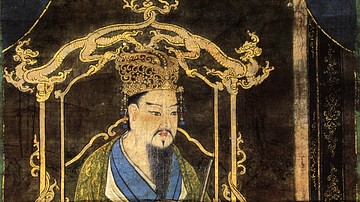
Emperor Kammu
Emperor Kammu (aka Kanmu) reigned in ancient Japan from 781 to 806 CE and is most noted for relocating the capital to Heiankyo (Kyoto) in 794 CE. Kammu was one of the most powerful emperors Japan had seen or would ever see, and his reign...

Definition
Titus (Roman Emperor)
Titus was Roman emperor from 79 to 81 CE. On June 24, 79 CE Titus Flavius Vespasianus succeeded his father Vespasian (r. 69-79 CE) as emperor of the Roman Empire. Prior to his ascension to the throne, he was considered by many as “…unpopular...
Definition
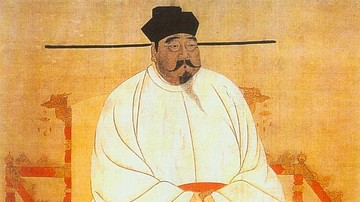
Emperor Taizu of Song
Emperor Taizu (960-976 CE), formerly known as Zhao Kuangyin, was the founder of the Song (aka Sung) dynasty which ruled China from 960 to 1279 CE. Taizu settled for a territorially smaller but more unified and prosperous China than was seen...
