
Search
Remove Ads
Advertisement
Search Results
Image
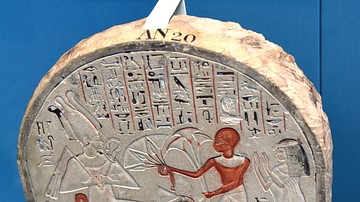
Egyptian Stela of Bakkay
A painted limestone stela where the deceased offers flowers to Osiris. Below, offerings are made to a couple named Huy and Henutnofret by four members of their family. From Egypt. 18th Dynasty, reign of Amenhotep III, circa...

Image
Egyptian Model of Servant Brewing Beer
This painted wooden model depicts a woman straining mash. There are eleven jars of beer in front of her. Old Kingdom, 6th Dynasty, 2345-2181 BCE. From tomb 45 at Asyut, modern-day Egypt. (The British Museum...
Image
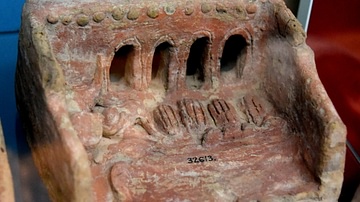
Egyptian Model of a Soul House
This is a model of a "soul house". The building has four arched doorways. Redware. Middle Kingdom, 12th Dynasty, 1985-1795 BCE. From Egypt, precise provenance of excavation is unknown. (The British Museum, London).
Image
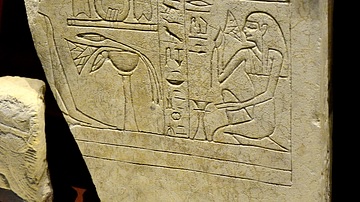
Egyptian Stela Showing Women Sitting Before Offerings
This fragment of a stela shows two women before tablets of offerings. From Abydos, Late Middle Kingdom, circa 1750 BCE. (National Museum of Ireland-Archaeology, Dublin, Republic of Ireland)

Image
Egyptian Fish Coffin
A wooden coffin shaped in the form of a Nile bolti fish and containing the mummified remains of a fish. Dynasty XXX-XXXI, 4th century BCE. (Egytpian Museum, Turin)

Image
Ancient Egyptian Relief of Working Men
This ancient Egtyptian relief of two men pulling a rope is made from stone and dates from the Intermedite Period or the Early Middle Kingdom (c. 2100-1940 BCE). It originally belonged to a necropolis and was...

Image
Egyptian Book of the Dead Fragment
Fragment of a linen mummy shroud with texts from the Book of the Dead, written in ink. From Thebes, Egypt. 18th Dynasty, circa 1500 BCE.

Image
Fractured Femur of an Egyptian Mummy
This right femoral bone shows evidence of malunion and misalignment of a healed fractured. From Abydos, Egypt. Late Period, after 664 BCE. (The British Museum, London)

Image
Ancient Egyptian Offering Basin
This offering basin made from stone dates from the time that Egypt was a province of the Roman Empire (30 BCE–641 CE). It was carved in the shape of an ankh, which symbolized life. (Musée du Cinquantenaire, Brussels...

Image
Egyptian Vessel with Galloping Horses
On this ceramic vessel, two piebald horses are depicted; they are galloping and harnessed. An ankh sign's hand grasps a was-scepter. Horses were introduced to Egypt by the Hyksos during the Second Intermediate...
