
Search
Remove Ads
Advertisement
Search Results

Image
Egyptian Beadnet Dress (Detail)
Egyptian beadnet dress from the reign of Khufu, 4th Dynasty, Old Kingdom of Egypt, 2551-2528 BCE. This beadnet dress is the earliest surviving example of a garment with the lozenge pattern. This pattern is frequently...

Article
Death in Ancient Egypt
To the ancient Egyptians, death was not the end of life but only the beginning of the next phase in an individual's eternal journey. There was no word in ancient Egyptian which corresponds to the concept of "death" as usually...

Article
Trade in Ancient Egypt
Trade has always been a vital aspect of any civilization whether at the local or international level. However many goods one has, whether as an individual, a community, or a country, there will always be something one lacks...

Definition
Roman Imperial Cult
The Roman imperial cult was the practice of venerating Roman emperors and their families as having divine attributes, honoring their contributions to the spread of Roman religion and culture. It was instituted by the first...
Article
The Forty-Two Judges
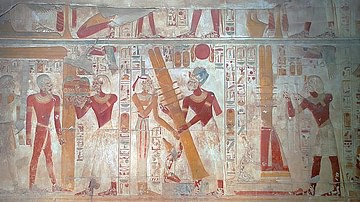
The Forty-Two Judges were divine entities associated with the afterlife in ancient Egypt and, specifically, the judgment of the soul in the Hall of Truth. The soul would recite the Negative Confession in their presence as...

Definition
Ull
Ull (also known as Ullr), with his bow and skis, is such an elusive presence in Norse mythology that no conclusive remarks can be made about him. The 13th-century Icelandic author Snorri describes him only briefly in his Prose Edda, and...

Image
Gods of Thunder
Gods of Thunder by Timothy R. Pauketat, Oxford University Press, 2023.
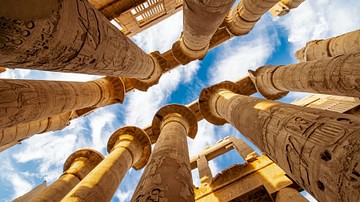
Image Gallery
A Gallery of Ancient Egyptian Temples
The temple in ancient Egypt was the home of the deity it was built for, and the clergy attended the statue of that god or goddess as they would a living person. Every temple was designed with a forecourt, a reception...

Definition
Etruscan Religion
The religion of the Etruscans, the civilization which flourished from the 8th to 3rd century BCE in central Italy, has, like many other features of the culture, long been overshadowed by that of its Greek contemporaries and Roman...

Definition
Izanami and Izanagi
Izanami ('she who invites') and Izanagi ('he who invites') are the primordial gods of the Shinto religion who are believed to have created the islands of Japan and given birth to many of the other Shinto gods or kami. The...
