
Search
Remove Ads
Advertisement
Search Results
Definition
Ganymede
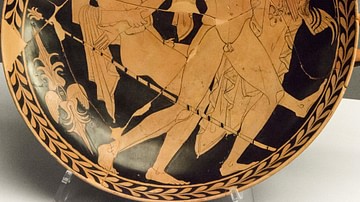
Ganymede (pronounced GAH-nuh-meed) is a youth in Greek mythology who is abducted by Zeus because of his great beauty and brought to Mount Olympus to serve as cupbearer. The story first appears in Homer’s Iliad without any suggestion...

Definition
Ancient Greek Religion
In the ancient Greek world, religion was personal, direct, and present in all areas of life. With formal rituals which included animal sacrifices and libations, myths to explain the origins of mankind and give the gods a...

Definition
Chogha Zanbil - The "Basket Mound" of the Gods
Chogha Zanbil (literally "basket mound") is an ancient Elamite temple complex located in the modern-day province of Khuzestan, Iran. It is also known as Dur-Untash (Fortress/City/Town of Untash), Tchogha...

Definition
Canaan
Canaan was the name of a large and prosperous ancient country (at times independent, at others a tributary to Egypt) located in the Levant region of present-day Lebanon, Syria, Jordan, and Israel. It was also known as Phoenicia. The origin...

Image
Egyptian Sarcophagus of Tetet
Cloth-covered, plastered and painted wood anthropoid coffin of Tetet, 22nd-24th Dynasty.
Egyptian Museum, Castello Sforzesco, Milan.

Article
The Lamentations of Isis and Nephthys
The Lamentations of Isis and Nephthys is an ancient Egyptian text in which the two goddess-sisters call the soul of the god Osiris to rejoin the living. The poem takes the form of a call-and-response liturgy and...

Article
The Mummy's Curse: Tutankhamun's Tomb & the Modern-Day Media
Howard Carter's 1922 CE discovery of the tomb of Tutankhamun was world-wide news but, following fast upon it, the story of the mummy's curse (also known as The Curse of the Pharaoh) became even...
Image
Egyptian Pottery Soul House
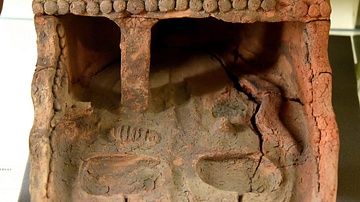
Redware pottery depicting the so-called "soul house", from E-Kab, Egypt, 11th to 12th Dynasties, 2024-1700 BCE. It has flattened pellets representing a loop of wood. One of the two pillars which supports the roof is...

Article
Setna II: A Detailed Summary & Commentary
Setna II (also Setna Khaemaus and Si-Osire) is a work of ancient Egyptian literature from Roman Egypt (30 BCE - 646 CE) written in demotic script. It is part of a cycle of stories known as the Tales of Prince...

Definition
Gutians - The Great Villains of the Sumerian Scribes
The Gutians were a West Asiatic people who are thought to have lived around the Zagros Mountains in a region referred to as Gutium. They had no written language and all that is known of them comes from...
