
Search
Remove Ads
Advertisement
Search Results

Definition
Set (Egyptian God)
Set, also known as Seth and Suetekh, was the Egyptian god of war, chaos, and storms, brother of Osiris, Isis, and Horus the Elder, uncle to Horus the Younger, and brother-husband to Nephthys. His other consort was the goddess...

Definition
Hyksos - The Rulers of Foreign Lands Who Transformed Egypt
The Hyksos were a West Semitic-speaking people who gained a foothold in Egypt circa 1782 BCE at the city of Avaris in Lower Egypt, thus initiating the era known in Egyptian history as the Second...

Definition
Ptolemaic Egypt
Ptolemaic Egypt existed between 323 and 30 BCE when Egypt was ruled by the Macedonian Ptolemaic dynasty. During the Ptolemaic period, Egyptian society changed as Greek immigrants introduced a new language, religious pantheon...

Definition
The Ankh
The Ankh is one of the most recognizable symbols from ancient Egypt, known as "the key of life" or "cross of life" and dated to the Early Dynastic Period (c. 3150 - 2613 BCE). It is a cross with a loop at the top sometimes ornamented...
Definition
Egyptian Medicine
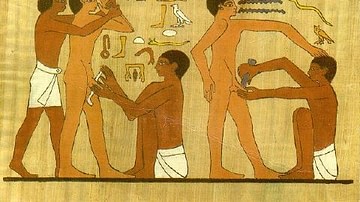
Medical practice in ancient Egypt was so advanced that many of their observations, policies, and commonplace procedures would not be surpassed in the west for centuries after the fall of Rome and their practices would inform...

Definition
Field of Reeds (Aaru)
A'Aru (The Field of Reeds) was the Egyptian afterlife, an idealized vision of one's life on earth (also known as Sekhet-A'Aru and translated as The Field of Rushes). Death was not the end of life but a transition to another...

Definition
Horus
Horus is the name of a sky god in ancient Egyptian mythology which designates primarily two deities: Horus the Elder (or Horus the Great), the last born of the first five original gods, and Horus the Younger, the son of Osiris and Isis...

Definition
The Kingdom of Kush
Kush was a kingdom in northern Africa in the region corresponding to modern-day Sudan. The larger region around Kush (later referred to as Nubia) was inhabited c. 8,000 BCE but the Kingdom of Kush rose much later. The Kerma...

Image
Sennedjem in the Afterlife
A wall-painting from the tomb of Sennedjem, an Egyptian craftsman, depicting the deceased blissfully ploughing his fields in the afterlife. Deir el-Medina, near Thebes, c. 1200 BCE.

Article
Rome's Egyptian Heritage
The Eternal City of Rome is one of the places in the world with the most historical sites to visit. The list of ancient ruins, museums, churches, and other historical landmarks makes the city an Eldorado for anyone interested...
