
Search
Remove Ads
Advertisement
Search Results

Video
Anubis: The Egyptian Jackal-Headed God of Mummifaction and the Afterlife
Anubis is the jackal-headed Egyptian god of mummification and the afterlife. He is depicted both as a jackal, and as a man with the head of a jackal. Anubis as a man is often depicted...

Article
Ancient Egyptian Agriculture
Agriculture was the foundation of the ancient Egyptian economy and vital to the lives of the people of the land. Agricultural practices began in the Delta Region of northern Egypt and the fertile basin known as the Faiyum...

Definition
Egyptian Faience
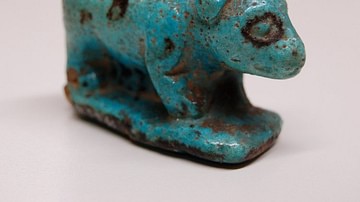
Egyptian faience is a glassy substance manufactured expertly by the ancient Egyptians. The process was first developed in Mesopotamia, first at Ur and later at Babylon, with significant results but faience production reached its...
Article
Dogs in Ancient Egypt
The dog as "man's best friend" has a long history going back to the ages long before the civilization of ancient Egypt was established but the Egyptians were among the earliest people to recognize the value of the dog and...

Article
Color in Ancient Egypt
The ancient Egyptians had a great appreciation for life which is clearly depicted through their art. Images of people enjoying themselves - whether in this life or the next - are as plentiful as those most often seen of the...

Video
Anubis: Egyptian god of the Afterlife
Anubis, the Egyptian god of the afterlife and mummification. One of the important roles of Anubis was as the "Guardian of the Scales" in the Underworld when the hearts of dead souls were weighed as a determining...
Definition
Serapis
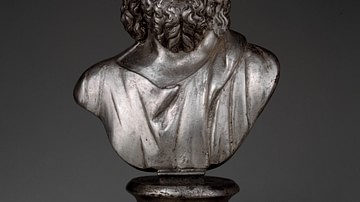
Serapis is a Graeco-Egyptian god of the Ptolemaic Period (323-30 BCE) of Egypt developed by the monarch Ptolemy I Soter (r. 305-282 BCE) as part of his vision to unite his Egyptian and Greek subjects. Serapis’ cult later spread throughout...

Definition
Religion in the Ancient World - Order and the Spiritual Experience
Religion (from the Latin Religio, meaning "restraint," or Relegere, according to Cicero, meaning "to repeat, to read again," or, most likely, Religionem, "to show respect for what is sacred"...

Definition
Set (Egyptian God)
Set, also known as Seth and Suetekh, was the Egyptian god of war, chaos, and storms, brother of Osiris, Isis, and Horus the Elder, uncle to Horus the Younger, and brother-husband to Nephthys. His other consort was the goddess...

Definition
Seshat
Seshat (also given as Sefkhet-Abwy and Seshet) is the Egyptian goddess of the written word. Her name literally means "female scribe" and she is regularly depicted as a woman wearing a leopard skin draped over her robe with a headdress...
