
Search
Remove Ads
Advertisement
Search Results

Definition
Portuguese Malacca
The Portuguese colonised Malacca (modern Melaka) on the southwest coast of the Malay peninsula from 1511 and kept it until 1641 when the Dutch took over. The port controlled the Malay Straits which lead from the Indian Ocean...

Definition
Edward Elgar
Edward Elgar (1857-1934) was an English composer best known for his orchestral music and oratorios. Amongst Elgar's most-loved works are his Pomp and Circumstance marches which inspired the choral Land of Hope and Glory, a rousing...

Definition
Medieval Folklore
Medieval folklore is a body of work, originally transmitted orally, which was composed between the 5th and 15th centuries in Europe. Although folktales are a common attribute of every civilization, and such stories were being...
Definition
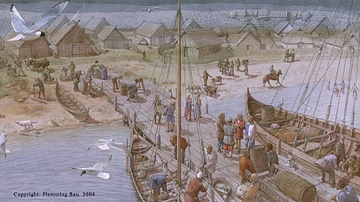
Kaupang
Kaupang was a Norwegian Viking Age town with a seasonal emporium established around c. 780 CE and abandoned around c. 950 CE. Kaupang is located on the western side of Oslofjord (Viksfjord) in what is the present-day southeastern county...

Definition
George II of Great Britain
George II of Great Britain (r. 1727-1760) was the second of the Hanoverian monarchs, and like his father George I of Great Britain (r. 1714-1727), he faced a Jacobite rebellion to restore the Stuart line. Wars in Europe...

Definition
Louis XIV of France - The Sun King
Louis XIV (1638-1715) reigned as King of France from 1643 to 1715. Known as Le Roi Soleil ('the Sun King'), he fervently believed in the concept of the 'divine right' of kings and is remembered for ruling as an absolute...

Definition
Saint Gall
Saint Gall (c. 550 - c. 645 CE), also known as Saint Gallus, was an Irish monk who lived in what is present-day Switzerland during the 6th century CE and was one of twelve companions of Saint Columbanus' Christian mission to the European...

Definition
Pre-Colonial North America
Pre-Colonial North America (also known as Pre-Columbian, Prehistoric, and Precontact) is the period between the migration of the Paleo-Indians to the region between 40,000-14,000 years ago and contact between indigenous...

Definition
Agora
The term agora (pronounced ah-go-RAH) is Greek for 'open place of assembly' and, early in the history of Greece, designated the area in a city where free-born citizens could gather to hear civic announcements, muster for military campaigns...

Interview
Interview: Buddhism in Korea
In this interview, James Blake Wiener, Co-Founder and Communications Director at Ancient History Encyclopedia (AHE), speaks to Emeritus Professor James H. Grayson, Professor of Korean Studies at the University of Sheffield...
