
Search
Remove Ads
Advertisement
Search Results

Image
Jar with Signs of Early Egyptian kings
This is a cylinder pottery jar (Type 50 B, pinkware). The name of King KA (and contents) was brushed on the jar using a black ink. King KA ruled just before the 1st Dynasty in Egypt. In general, few vessels from...

Image
Shaft-Hole Axe from Early Dynastic Period
This shaft-hole axe dates back to the early dynastic period,2800-2350 BCE, Mesopotamia, Iraq. (The Sulaimaniya Museum, Iraq).

Definition
Canaan
Canaan was the name of a large and prosperous ancient country (at times independent, at others a tributary to Egypt) located in the Levant region of present-day Lebanon, Syria, Jordan, and Israel. It was also known as Phoenicia. The origin...

Article
Caesarea Maritima's Role in the Roman Empire
Caesarea Maritima, the city Herod the Great (r. 37-4 BCE) built for Rome on the southeastern coast of the Mediterranean served as the Roman Empire's powerbase of operations both commercially and militarily...

Image
Early Elamite Clay Tablet with Numerical Signs from Southern Iran
Early Elamite clay tablet with numerical signs found in Tappeh Yahya, Kerman, dating to c. 3100 to 2900 BCE (Yahya Period IVc). National Museum of Iran, Tehran, inv. no. 4065. Photo by...

Image
Map of Early Human Migrations
This map illustrates the early global migrations of Homo sapiens—our species’ remarkable journey from Africa to every inhabitable continent. Tracing movements that began over hundreds of thoussands of years ago, it...
Image
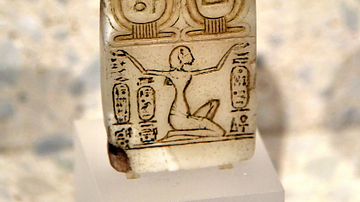
Early Cartouche of the God Aten
Early cartouche of the god Aten, calcite alabaster. New Kingdom of Egypt, 18th Dynasty, 1351-1334 BCE. At the upper part of this votive plaque of the God Aten, there are two "early" cartouches of Aten. On the right...

Image
Folio of Early Pauline Espitles
A folio from P46, an early 3rd century collection of Pauline epistles. Folio from Papyrus 46, an early 3rd century collection of Pauline epistles, containing 2 Corinthians 11:33-12:9 Transcription (the bracketed...
Image
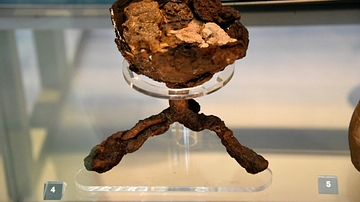
Lamp from Early Anglo-Saxon England
This iron lamp, comprising a round bowl on a tripod foot, still contains the remains of beeswax fuel, but no trace of a wick has survived. Iron lamps are extremely rare finds from early Anglo-Saxon England. So...
Image
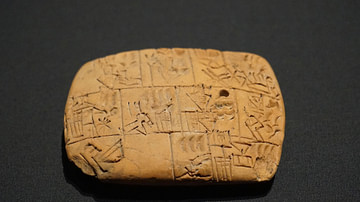
Early Writing Tablet
This table is made of clay and was found in Southern Iraq (3100-3000 BCE). Early writing was used as a way to keep track of the administration and it was only in later years its uses evolved. Early writing in Mesopotamia was...
