
Search
Remove Ads
Advertisement
Search Results

Definition
King Philip's War
King Philip’s War (also known as Metacom’s War, 1675-1678) was a conflict in New England between a coalition of Native American tribes organized under the command of Metacom (also known as King Philip, l. 1638-1676), chief of the Wampanoag...

Definition
War of the Fifth Coalition
The War of the Fifth Coalition (1809) was a major conflict of the Napoleonic Wars (1803-1815) that was fought primarily in Central Europe between the First French Empire and its client states against the Austrian Empire, supported by the...
Definition
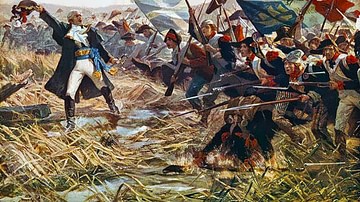
Battle of Jemappes
The Battle of Jemappes was a decisive battle in the War of the First Coalition (1792-97), part of the French Revolutionary Wars (1792-1802). On 6 November 1792, a French army under General Charles-François Dumouriez defeated an Austrian force...
Definition
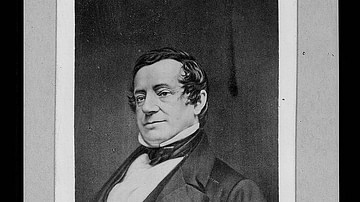
Washington Irving
Washington Irving (1783-1859) was an American author, essayist, and diplomat best known for his short stories The Legend of Sleepy Hollow and Rip Van Winkle. He was the first professional American author and also the first to achieve an international...
Image
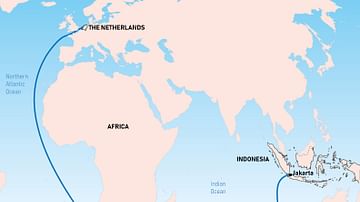
The Brouwer Route
The Dutch East India Company's favoured route from Europe to southeast Asia was known as the Brouwer Route. It was discovered by Dutch explorer Hendrik Brouwer (c. 1581-1643) in 1611 and halved the sailing time from the Netherlands to the...

Article
The Printing Revolution in Renaissance Europe
The arrival in Europe of the printing press with moveable metal type in the 1450s CE was an event which had enormous and long-lasting consequences. The German printer Johannes Gutenberg (c. 1398-1468 CE) is widely credited with the innovation...
Article
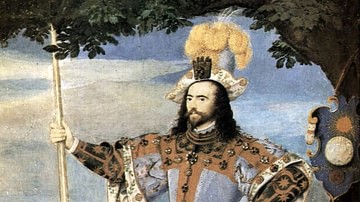
Clothes in the Elizabethan Era
Clothes in the Elizabethan era (1558-1603 CE) became much more colourful, elaborate, and flamboyant than in previous periods. With Elizabeth I of England (r. 1558-1603 CE) herself being a dedicated follower of fashion, so, too, her court...

Article
Trade Goods of the East India Company
The English East India Company (EIC) was founded in 1600, and it came to control both trade and territories in India, as well as a trade monopoly with China. Goods the EIC traded included spices, cotton cloth, tea, and opium, all in such...

Article
The Portuguese in East Africa
The Portuguese first took an interest in East Africa from the beginning of the 16th century as their empire spread eastwards across the Indian Ocean. Trade in the region was already well-established and carried out by Africans, Indians, and...

Article
Life on a Colonial Sugar Plantation
Raising sugar cane could be a very profitable business, but producing refined sugar was a highly labour-intensive process. For this reason, European colonial settlers in Africa and the Americas used slaves on their plantations, almost all...
