
Search
Remove Ads
Advertisement
Search Results

Article
The Armies of the Crusades
The armies of the Crusades (11th-15th centuries CE), which saw Christians and Muslims struggle for control of territories in the Middle East and elsewhere, could involve over 100,000 men on either side who came from all...

Article
Early Muslim Conquests (622-656 CE)
Islam arose as a religious and socio-political force in Arabia in the 7th century CE (610 CE onwards). The Islamic Prophet Muhammad (l. 570-632 CE), despite facing resistance and persecution, amassed a huge following...

Article
The Spread of Islam in Ancient Africa
Following the conquest of North Africa by Muslim Arabs in the 7th century CE, Islam spread throughout West Africa via merchants, traders, scholars, and missionaries, that is largely through peaceful means whereby...

Article
Alexander the Great as a God
The age-old concept of the “divine right of kings” allowed that a country's ruler received his or her power or authority from God. However, few, if any, were delusional enough to actually believe themselves to be a god...

Article
Caesarea Maritima's Role in the Mediterranean Trade
Caesarea Maritima was located on the eastern coast of the Mediterranean Sea. Built from the ground up in 22-10 BCE by Rome's client king, Herod the Great (r. 37-4 BCE), its location in relation to ship...
Image
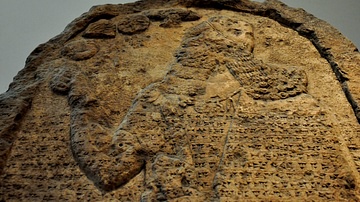
Kurkh Stela of Shalmaneser III
This is a close-up view of the upper part of the stela, depicting Shalmaneser III praying in front of divine symbols (Ashur, Ishtar, Anu, and Sin). The cuneiform inscription is a text of a version of the King's annals...

Image
Baalbek, Lebanon
Baalbek is an ancient Phoenician city located in what is now modern-day Lebanon, in the northern part of the Beqaa Valley, a fertile area with plentiful springs. First settled at the beginning of the 3rd millennium BCE, Baalbek...

Image
Limestone Relief of an Aramaean King
This piece of limestone was roughly cut into an unusual stele depicting a standing Aramaean King. One of the king's hand holds a long spear or staff while the other hand holds a tulip. 11th century BCE. From Tell-...
Image
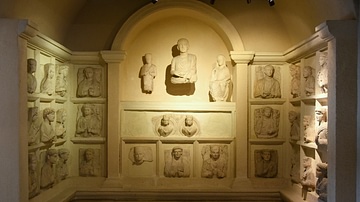
Subterranean Tomb from Palmyra
The hypogea or underground tombs, along with the tower tombs and house tombs, constitute an important part of the monumental burials of the wealthy Palmyrene class in the first and second centuries CE. The underground...

Image
Twelve Steels That Forged History - Metallurgical Revolutions That Changed Civilization.
Steel, an alloy based principally on iron and carbon, has been one of humanity’s most transformative materials. From early bloomery production in the ancient Near East to...
