
Search
Did you mean: Column?
Remove Ads
Advertisement
Search Results

Definition
Battle of Neerwinden
The Battle of Neerwinden saw the major defeat of a French republican army by an allied force of Austrians and Dutch during the War of the First Coalition (1792-97), part of the broader French Revolutionary Wars (1792-1802...
Definition
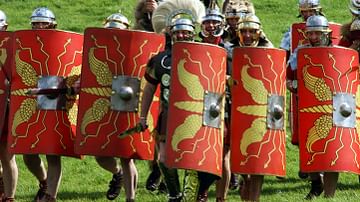
Legio I Germanica
Legio I Germanica was a Roman legion that won acclaim early under Augustus (27 BCE - 14 CE) but was stripped of its title for cowardice. Stationed on the Lower Rhine, the legion mutinied in 14 CE and then faced disgrace when...
Definition
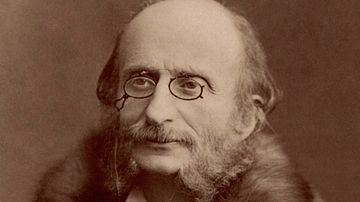
Jacques Offenbach
Jacques Offenbach (1819-1880) was a composer of German birth who took French citizenship and became famous in Paris for his comic operettas, a genre he created, and for the more serious opera, The Tales of Hoffmann. A virtuoso...

Image
Roman Painted Goblet with Achilles
This painted goblet dates from the first half of the 3rd century CE, and it was found in 1991 when archaeologists opened an ash casket located on Richard Wagner Straße in Cologne, Germany. The brilliant enamel paint...

Image
Memorial to Deceased Roman Cavalryman
All that remains of this stone memorial is a portrait of the deceased Roman cavalryman. The prototype of this kind of portrait can be traced to Hellenistic Greece. This memorial was found in Cologne, Germany and...

Image
Roman Oil Lamp
Oil lamp in the form of a wine barrel found in Cologne (Germany), Roman Empire. (Romisch-Germanisches Museum, Cologne)

Image
Gladiator Helmet-Shaped Dropper Flask
Gladiator helmet-shaped dropper flask decorated with "snake thread" trails, found in Cologne, Germany, dated to the 3rd century CE.
Römisch-Germanisches Museum, Cologne.

Article
The Weapons of an English Medieval Knight
The weapons of an English medieval knight in combat included the long sword, wooden lance with an iron tip, metal-headed mace, battle-axe, and dagger. Trained since childhood and practised at tournaments, the...

Article
Monastic Orders of the Middle Ages
The monastic orders of the Middle Ages developed from the desire to live a spiritual life without the distractions of the world. Men and women who took religious vows were seeking a purity of experience they found...

Article
Enemies of Rome in the 3rd Century CE - The Greatest Enemy of Rome was Rome Itself
It has been said that the greatest enemy of Rome was Rome itself, and this is certainly true of the period known as the Crisis of the Third Century (also known as the Imperial...
