
Search
Did you mean: Column?
Remove Ads
Advertisement
Search Results
Image
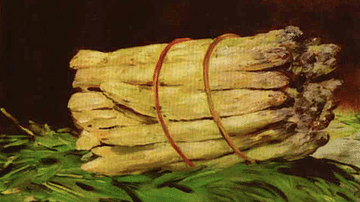
Bunch of Asparagus by Manet
An 1880 oil on canvas still life, Bunch of Asparagus, by Edouard Manet (1832-83), the French modernist painter. Manet was particularly interested in still life, especially towards the end of his career. The work was bought...
Image
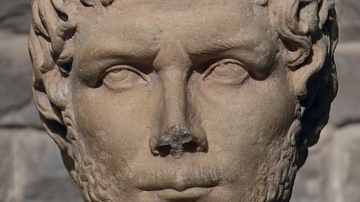
Emperor Gallienus
Portrait bust of Emperor Gallienus, 3rd century CE, Romisch-Germanisches Museum, Cologne
Image
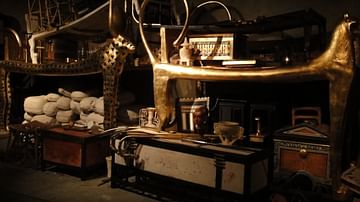
Antechamber of Tutankhamun's Tomb
A reproduction of the Antechamber at the "Tutankhamun: His Tomb & His Treasures" exhibit in Cologne.
Image
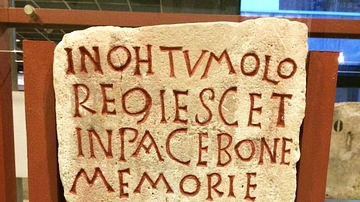
Gravestone for German Man in Latin
This is a 6th century CE gravestone for a German man named Leo. The text is in Latin. (Translation of the text into English: "In this tomb rests in peace Leo of good memory. He lived for 52 years. He died the day...
Image
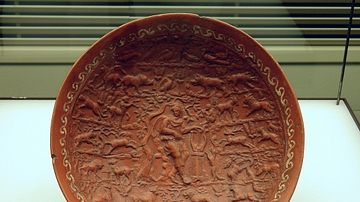
Dish with Orpheus among the animals
Dish with Orpheus among the animals exhibited at the Römisch-Germanisches Museum in Cologne (Germany).

Image
Aeneas Carrying Anchises
Limestone statue group depicting Aeneas carrying Anchises, from a mausoleum of Cologne, 2nd century CE. LVR-LandesMuseum Bonn, Germany.
Image
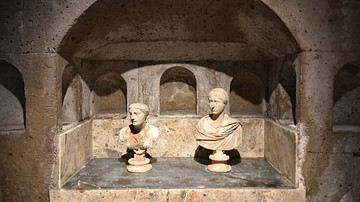
The Weiden Burial Chamber
The Weiden burial chamber, Colonia Agrippina, (Cologne, Germany), dated to the 2nd-4th century CE.

Image
Merovingian Jar
The Franks continued to produce glass vessels and wheel-made pottery using Roman methods, but the finer skills were lost and glassware became a luxury, used only at high status feasts. Roman glass-making centers in the Rhineland...

Image
Postumus
Silver coin depicting Emperor Postumus (260-269 CE), minted in Cologne.
British Museum, London.
Image
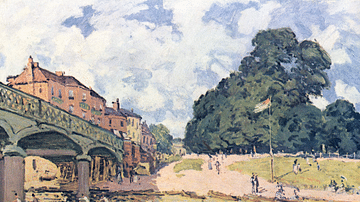
The Bridge at Hampton Court by Sisley
An 1874 oil on canvas, The Bridge at Hampton Court, by Alfred Sisley (1839-1899), the Franco-British impressionist painter. (Wallraf-Richartz Museum, Cologne, Germany)
