
Search
Remove Ads
Advertisement
Search Results

Definition
Ancient Egyptian Religion
Egyptian religion was a combination of beliefs and practices which, in the modern day, would include Egyptian mythology, science, medicine, psychiatry, magic, spiritualism, herbology, as well as the modern understanding of 'religion' as belief...

Definition
Field of Reeds (Aaru)
A'Aru (The Field of Reeds) was the Egyptian afterlife, an idealized vision of one's life on earth (also known as Sekhet-A'Aru and translated as The Field of Rushes). Death was not the end of life but a transition to another part of one's...

Article
Mummification in Ancient Egypt
The practice of mummifying the dead began in ancient Egypt c. 3500 BCE. The English word mummy comes from the Latin mumia which is derived from the Persian mum meaning 'wax' and refers to an embalmed corpse which was wax-like. The idea of...

Article
The Rock-Cut Tombs of Qizqapan, Iraqi Kurdistan: Median or Achaemenid?
O Creator of the material world, at what distance from the holy man (should the place for the dead body be)?" Ahura Mazda replied: "Three paces from the holy man". (Vend. 8. 6-7) In September 2009 CE, one of my relatives suggested that we...

Definition
Ancient Egyptian Mythology
Egyptian mythology was the belief structure and underlying form of ancient Egyptian culture from at least c. 4000 BCE (as evidenced by burial practices and tomb paintings) to 30 BCE with the death of Cleopatra VII, the last ruler of the Ptolemaic...
Definition
Isis
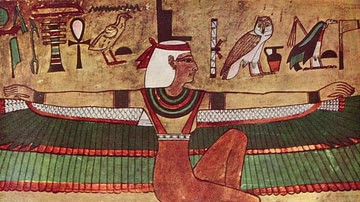
Isis is an ancient Egyptian goddess who became the most popular and enduring of all the Egyptian deities. Her name comes from the Egyptian Eset, ("the seat") which referred to her stability and also the throne of Egypt as she was considered...

Article
Ancient Mesopotamian Beliefs in the Afterlife
Unlike the rich corpus of ancient Egyptian funerary texts, no such “guidebooks” from Mesopotamia detail the afterlife and the soul's fate after death. Instead, ancient Mesopotamian views of the afterlife must be pieced together from a variety...

Article
Magic in Ancient Egypt
In ancient Egypt, if a woman were having difficulty conceiving a child, she might spend an evening in a Bes Chamber (also known as an incubation chamber) located within a temple. Bes was the god of childbirth, sexuality, fertility, among...
Article
The Egyptian Afterlife & The Feather of Truth
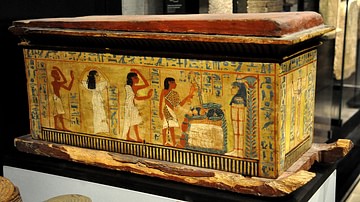
Is it possible to have a heart that is lighter than a feather? To the ancient Egyptians it was not only possible but highly desirable. The after-life of the ancient Egyptians was known as the Field of Reeds, a land just like what one knew...
Definition
Arslan Tash Amulet
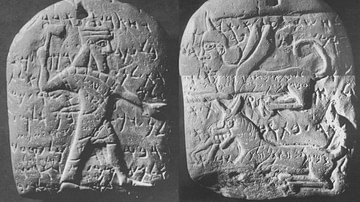
Dated to the 7th century BCE, the Arslan Tash amulet (AT1) was discovered in Arslan Tash, Syria and contains the writing of Phoenician, magic incantations. The limestone plaque includes a variety of features: incantations perceived to prevent...
