
Search
Remove Ads
Advertisement
Search Results

Definition
Bastet
Bastet is the Egyptian goddess of the home, domesticity, women's secrets, cats, fertility, and childbirth. She protected the home from evil spirits and disease, especially diseases associated with women and children. As with many deities...

Article
The Printing Revolution in Renaissance Europe
The arrival in Europe of the printing press with moveable metal type in the 1450s CE was an event which had enormous and long-lasting consequences. The German printer Johannes Gutenberg (c. 1398-1468 CE) is widely credited with the innovation...

Article
Maya Writing
The Maya hieroglyphic writing system was a sophisticated combination of pictographs directly representing objects and ideograms (glyphs) expressing more abstract concepts such as actions, ideas and syllabic sounds. Maya writing has survived...

Definition
The Negative Confession
The Negative Confession (also known as The Declaration of Innocence) is a list of 42 sins which the soul of the deceased can honestly say it has never committed when it stands in judgment in the afterlife. The soul would recite these in the...

Definition
Renaissance Humanism
Renaissance Humanism was an intellectual movement typified by a revived interest in the classical world and studies which focussed not on religion but on what it is to be human. Its origins went back to 14th-century Italy and such authors...

Definition
Enoch
In the book of Genesis in the pre-flood period, Enoch was the son of Jared and the father of Methuselah. There are few details about Enoch. We learn that he lived 365 years, and then Enoch "walked faithfully with God; then he was no more...

Definition
The Constantinian Excerpts - The 10th Century Byzantine Encyclopedia
The Constantinian Excerpts, or Excerpta Constantiniana is the conventional name given to the mid-10th Century Byzantine palace encyclopedia commissioned by the scholar emperor Constantine VII ‘Porphyrogenitus’ (reign 945-959). It was a work...

Article
The Admonitions of Ipuwer - A Tale of Chaos and the Importance of Government
The Admonitions of Ipuwer (also known as The Papyrus Ipuwer and The Admonitions of an Egyptian Sage) is a literary text dated to the Middle Kingdom of Egypt (2040-1782 BCE). The only extant copy of the work, preserved on the Papyrus Leiden...
Article
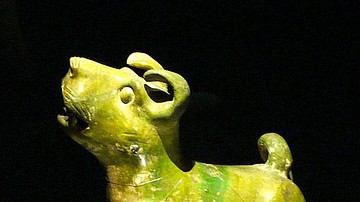
Dogs in Ancient China
Dogs are the oldest domesticated animal in China and were bred as guardians, for transporting goods, for herding, hunting, and as a food source. Archaeological evidence dates the domestication of the dog in China at approximately 15,000 years...

Article
Medicine in Ancient Mesopotamia - A Gift of the Gods to Their People
In ancient Mesopotamia, the gods informed every aspect of daily life, including the practice of medicine. Gula, the Sumerian goddess of healing, presided over the medical arts, guiding doctors and dentists in the treatment of health problems...
