
Search
Remove Ads
Advertisement
Search Results
Image
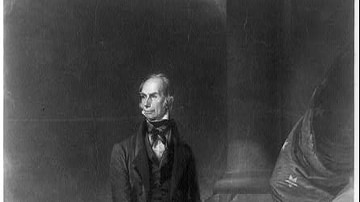
Henry Clay
Portrait of Henry Clay by John Neagle, 1843.
Library of Congress, Washington, D.C.

Image
Curse Tablet from Pella, Ancient Kingdom of Macedonia
Pella curse tablet, lead scroll, first half of the 4th century BCE. Writing and dedicating a curse tablet (katadesmos) was an act of practical magic in the Greco-Roman world. Curse tablets were fragmental sheets of lead—or, in rare instances...

Image
Cuneiform Tablet with Envelope from Alalakh
This clay tablet still has its clay envelope. The tablet mentions a legal case before Niqmepuh, King of Iamhad (Aleppo) concerning the legacy of two houses. The seal impressions of ten witnesses (including the King) survive on the fragmentary...
Image
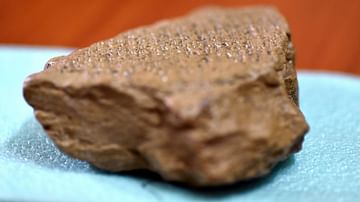
Newly Discovered Tablet II of the Epic of Gilgamesh
This is the newly discovered Tablet II of the Epic of Gilgamesh. The upper surface is the obverse. The image was intentionally shot focusing on the center because the tablet has not been published yet. The cuneiform text has been transliterated...

Article
Hymn to Nisaba
The Hymn to Nisaba (c. 3rd millennium BCE) is a poem praising Nisaba, the Sumerian goddess of writing and accounts who also served as scribe of the gods. The poem is officially dedicated to Enki, the god of wisdom (sometimes given as her...

Definition
Linear B Script
Linear B script was the writing system of the Mycenaean civilization of the Bronze Age Mediterranean. The syllabic script was used to write Mycenaean Greek from c. 1500 to c. 1200 BCE. It was deciphered by Michael Ventris in 1952, and so...
Image
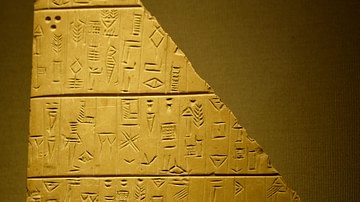
Mesopotamian Tablet with Puchase Details from Dilbat
This tablet lists purchases of land by a man named Tupsikka, with payments made in baskets of barley. One transaction reads "The price of the field is 90 gur-sag-gal 16 quarts of oil". Stone tablet, about 2400-2200 BCE. Excavated by Hormuzd...
![Newly Discovered Tablet II of the Epic of Gilgamesh [Reverse]](https://www.worldhistory.org/img/c/p/360x202/10430.jpg?v=1736607132)
Image
Newly Discovered Tablet II of the Epic of Gilgamesh [Reverse]
This is the reverse of the newly discovered Tablet II of the Epic of Gilgamesh. The cuneiform text (on the obverse) has been transliterated by Professor Farouk Al-Rawi and an article will be published by him soon. The cuneiform inscription...

Article
New Gilgamesh Fragment: Enkidu's Sexual Exploits Doubled
Sometimes it is the smallest discoveries that have the largest impact. When Alexandra Kleinerman and Alhena Gadotti found a new fragment of the Epic of Gilgamesh in 2015 CE, it did not seem to be particularly impressive. The broken tablet...

Image
Part of Tablet V, the Epic of Gilgamesh
A newly discovered partially broken tablet V of the Epic of Gilgamesh: "the episode of the journey of Gilgamesh and Enkidu." According to Professor Farouk Al-Rawi (of the School of Oriental and African Studies, University of London), this...
