
Search
Remove Ads
Advertisement
Search Results
![Illegally Excavated Mesopotamian Clay Tablet [11]](https://www.worldhistory.org/img/c/p/360x202/7094.jpg?v=1771874954)
Image
Illegally Excavated Mesopotamian Clay Tablet [11]
This clay tablet was illegally excavated. The precise provenance of the excavation is unknown, but probably from Southern Mesopotamia, modern-day Iraq. It is currently housed in the Sulaymaniyah Museum, Iraqi Kurdistan.

Image
End View, Illegally Excavated Mesopotamian Clay Tablet
This clay tablet was illegally excavated. The precise provenance of the excavation is unknown, but probably from Southern Mesopotamia, modern-day Iraq. It is currently housed in the Sulaymaniyah Museum, Iraqi Kurdistan.
![Illegally Excavated Mesopotamian Clay Tablet [8]](https://www.worldhistory.org/img/c/p/360x202/7091.jpg?v=1618722903)
Image
Illegally Excavated Mesopotamian Clay Tablet [8]
This clay tablet was illegally excavated. The precise provenance of the excavation is unknown, but probably from Southern Mesopotamia, modern-day Iraq. It is currently housed in the Sulaymaniyah Museum, Iraqi Kurdistan.
![Illegally Excavated Mesopotamian Clay Tablet [9]](https://www.worldhistory.org/img/c/p/360x202/7102.jpg?v=1599475503)
Image
Illegally Excavated Mesopotamian Clay Tablet [9]
This clay tablet was illegally excavated. The precise provenance of the excavation is unknown, but probably from Southern Mesopotamia, modern-day Iraq. It is currently housed in the Sulaymaniyah Museum, Iraqi Kurdistan.
![Illegally Excavated Mesopotamian Clay Tablet [6]](https://www.worldhistory.org/img/c/p/360x202/7100.jpg?v=1771908366)
Image
Illegally Excavated Mesopotamian Clay Tablet [6]
This clay tablet was illegally excavated. The precise provenance of the excavation is unknown, but probably from Southern Mesopotamia, modern-day Iraq. It is currently housed in the Sulaymaniyah Museum, Iraqi Kurdistan.
![Illegally Excavated Mesopotamian Clay Tablet [3]](https://www.worldhistory.org/img/c/p/360x202/7101.jpg?v=1771874964)
Image
Illegally Excavated Mesopotamian Clay Tablet [3]
This clay tablet was illegally excavated. The precise provenance of the excavation is unknown, but probably from Southern Mesopotamia, modern-day Iraq. It is currently housed in the Sulaymaniyah Museum, Iraqi Kurdistan.

Image
Death of Alexander Clay Tablet
This is a diary of astronomical and meteorological phenomena observed during the 2nd month of the years 323-322 BCE. Written in cuneiform inscription, it records the death of Alexander on the 29th day of the lunar month. The author describes...
Image
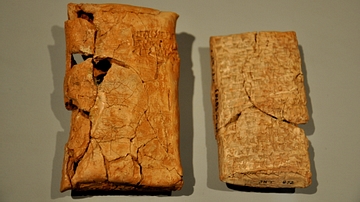
A Clay Tablet with its Envelope
A commercial letter (clay tablet) enclosed by an envelope (a clay covering). The letter was supposed to be opened by the recipient. 2nd millennium BCE, Mesopotamia, Iraq. (The Sulaimaniya Museum, Iraq).

Image
Early Elamite Clay Tablet with Numerical Signs from Southern Iran
Early Elamite clay tablet with numerical signs found in Tappeh Yahya, Kerman, dating to c. 3100 to 2900 BCE (Yahya Period IVc). National Museum of Iran, Tehran, inv. no. 4065. Photo by Nima Fakoorzadeh (Baloot Noghrei) Tappeh Yahya in...
Image
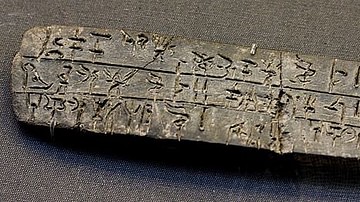
Linear B Clay Tablet
Example of a Linear B clay tablet found at Knossos. It records quantities of oil apparently offered to various deities.
