
Search
Remove Ads
Advertisement
Search Results
Image
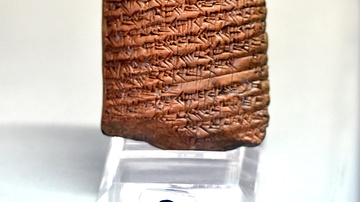
Geometric-Algebraic Theory Clay Tablet from Tell al-Dhabba'i
This clay tablet narrates a geometric-algebraic theory of how to make a solution for a mathematical problem. The conclusion applies a theory very similar to the Pythagorean theorem. From Tell Tell al-Dhabba'i, Iraq. Old-Babylonian period...
Image
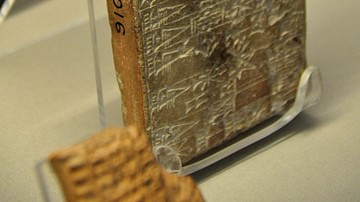
Foundation Clay Tablet from Larsa
This clay tablet records the restoration of the temple of the sun god Shamash at Larsa (modern-day Sankarah or Tell as-Senkereh) by King Hammurabi. Old Babylonian Period, reign of Hammurabi, 1792-1750 BCE. From Larsa, Southern Mesopotamia...
Image
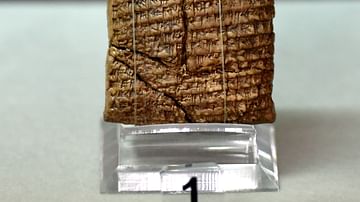
Geometric-Algebraic Theory Clay Tablet from Tell Harmal
This clay tablet narrates a geometric-algebraic theory of angles and triangles, similar to to the theory of Euclid of Alexandria, the father of geometry (lived c. 300 BCE). From Tell Harmal (ancient Shaduppum), Iraq. Old-Babylonian period...
Image
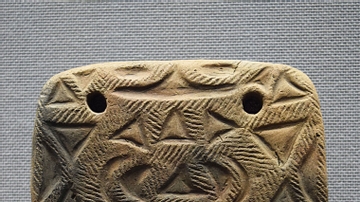
Doban Clay Tablet from Japan
This doban or clay tablet is from the Fukuda Shell Mound in what is present-day Ibaraki prefecture, Japan. It dates from the Jomon period, between 1000-400 BCE. Important cultural property. (Tokyo National Museum)
Image
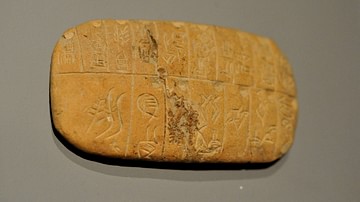
Economic Clay Tablet
This tablet contains a list of goods. From Mesopotamia, Iraq. Early dynastic period, 3rd millennium BCE. The Sulaimaniya Museum, Iraq.
Image
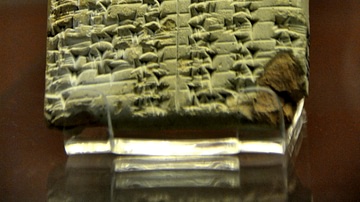
Kassite-Akkadian Lexical Clay Tablet
Vocabulary giving the Akkadian equivalents of 48 Kassite words of the type found in personal names. The Kassite words are listed on the left of each column with their Babylonian equivalent to the right. 1200-800 BCE. From Babylon, Mesopotamia...
Image
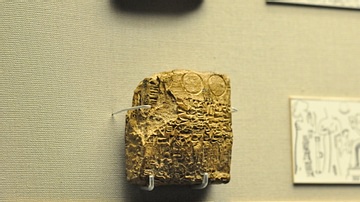
Unopened Clay Tablet Envelope from Kultepe
The cuneiform text on the center of this unopened envelop narrates a loan of silver to a husband and wife. The envelop is marked by rings and cylinder seals used by the diverse community at the city of Kultepe. There are 3 scenes; Babylonian...

Image
Clay Cover of the Tablet of Shamash
This is a fired clay cover of the sun god (Shamash) tablet. Its purpose was to protect the obverse side (face) of the tablet. It has retained the impression of the carved panel of the tablet. The Babylonian king Nabu-apla-iddina (reigned...

Image
Clay Cover of the Tablet of Shamash (II)
This is a fired clay cover of the sun god (Shamash) tablet. Its purpose was to protect the obverse side (face) of the tablet. It has retained the impression of the carved panel of the tablet. The Babylonian king Nabu-apla-iddina (reigned...

Article
Mesopotamian Education - Creating the First Written Works in History
Mesopotamian education was invented by the Sumerians following the creation of writing circa 3600/3500 BCE. The earliest schools were attached to temples, but later schools were established in separate buildings, in which the scribes of ancient...
