
Search
Remove Ads
Advertisement
Search Results
Image
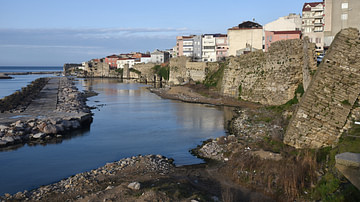
Fortifications Walls of Sinope
The north fortification walls of Sinope, known today as Sinop Castle (Turkish: Sinop Kalesi), located in the city of Sinop on the northernmost edge of the Turkish side of the Black Sea coast. Sinope was the earliest Greek colony founded on...

Image
Piraeus & The Long Walls
An illustration of the Long Walls fortifications which connected the city of Athens to its port of Piraeus from the 5th century BCE.
Image
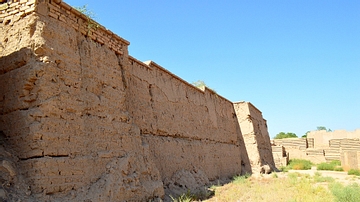
The Inner walls of Babylon
This wall is part of a large and long wall at the ancient city of Babylon, in modern-day Iraq. The walls lie before the so-called Southern Palace of Nebuchadnezzar II. Neo-Babylonian period, reign of Nebuchadnezzar II, 6th century BCE.

Image
Chester Walls: Civil War Damage
Siege damage to the Chester City Walls following the First English Civil War, 1645 - 1646 CE.
Article
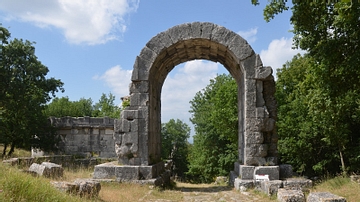
Visitor’s Guide to Carsulae (San Damiano)
Carsulae in Umbria, central Italy, was founded c. 300 BCE and only became a prosperous urban centre after it was connected by the Via Flaminia towards the end of the 3rd century BCE. It was granted the status of municipium and acquired a...
Image
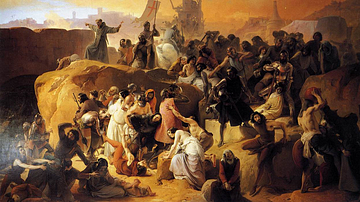
Crusaders at the Walls of Jerusalem
A 19th century CE painting by Francesco Hayez of the First Crusaders at the walls of Jerusalem in 1099 CE. (Royal Palace of Turin, Italy)

Image
Walls of Jericho
Exacvated remains of the fabled walls of Jericho, c. 8000 BCE. The stone wall was originally 3.6 meters (11.8 feet) high and 1.8 meters (5.9 feet) wide at the base.

Image
Adobe Walls, Chan Chan
A section of the decorated adobe walls of one of the palace compounds in Chan Chan, northern Peru. Chan Chan was the capital of the Chimu (Chimor) civilization which flourished between the 12th and 15th centuries CE.

Image
Fortification Walls, Sacsayhuaman
A section of the fortification walls of the Inca Sacsayhuaman (also Saqsawaman) fortress-temple complex of northern Cusco, 13th-15th century CE.

Image
Star of David on the Walls of Jerusalem
The star is located near the New Gate on the northern part of the walls of Jerusalem.
