
Search
Remove Ads
Advertisement
Search Results

Definition
New Testament
New Testament is the name for the second half of the Christian Bible, compiled from the 2nd century CE, after the separation of Christianity from Judaism. The Christian Bible retained books of the Jewish scriptures, the Old Testament...

Image
Vladimir I Converting to Christianity
A 19th century CE fresco by Viktor Mikhailovich Vasnetsov in kieve depicting the baptism of the Kievan Rus leader Saint Prince Vladimir (r. 980-1015 CE)

Definition
Roman Empire
The Roman Empire, at its height (c. 117), was the most extensive political and social structure in western civilization. Building upon the foundation laid by the Roman Republic, the empire became the largest and most powerful political...

Article
A Traditional Japanese House
The traditional house of ancient and medieval Japan (1185-1606 CE) is one of the most distinctive contributions that country has made to world architecture. While the rich and powerful might have lived in castles and...
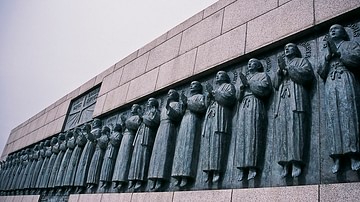
Image
Memorial of the 26 Martyrs of Japan in Nagasaki
Memorial of the 26 Martyrs of Japan in Nagasaki, who were executed for their Christian beliefs in 1597, after Japan had outlawed the religion. Canonised by the Catholic Church, the martyrs were tortured...

Definition
Ise Grand Shrine
The Ise Grand Shrine or Ise Jingu, located in the heart of a sacred forest in the Mie Prefecture of Japan, is the most important Shinto shrine in the country and is dedicated to the sun goddess Amaterasu with a separate shrine...

Definition
Mount Fuji - Japan's Tallest and Most Sacred Mountain
Mt. Fuji (Fujisan) is the tallest mountain in Japan and, with its classically symmetrical snow-capped cone, has long been the symbol of that country. The volcano is regarded as a sacred kami or spirit...

Definition
Queen Himiko
Queen Himiko, also known as Pimiko or Pimiku (183? - 248 CE), was a 3rd-century CE ruler of the territory in ancient Japan known as Hsieh-ma-t'ai or Yamatai, later to be known as Yamato. Considered by the Chinese as the ruler of...

Definition
Ninigi
Ninigi-no-Mikoto, or simply Ninigi, is the grandson of the supreme Shinto deity Amaterasu, the sun goddess. He is the son of Ama-no-Oshiho-mimi and, descending to earth as the first just ruler, he brought with him gifts from Amaterasu...

Definition
Jomon Period
The Jomon Period is the earliest historical era of Japanese history which began around 14500 BCE, coinciding with the Neolithic Period in Europe and Asia, and ended around 300 BCE when the Yayoi Period began. The name Jomon, meaning...
