
Search
Remove Ads
Advertisement
Search Results

Definition
Ancient Korean Coinage
The coinage of ancient Korea (pre-13th century CE) first employed Chinese coins, known locally as the oshuchon. Korean rulers began minting their own metal coins from the late 10th century CE, first in copper and iron, and...

Definition
Sui Dynasty
The Sui Dynasty (581-618 CE) was a brief one with only two reigning emperors but it managed to unify China following the split of the Northern and Southern Dynasties period. As had happened previously in Chinese history, a short-lived...

Article
Old Testament Pseudepigrapha
The Old Testament Pseudepigrapha are the non-canonical writings of Judaism and Christianity, ranging from the 5th century BCE to the 9th century CE. Pseudepigrapha comes from a Greek noun denoting writings with a false...

Definition
Jade Emperor
The Supreme August Jade Emperor is the supreme deity of Chinese tradition and is otherwise known as Yuhuang Shangdi (Yu-huang Shang-ti), Yudi (Yu Ti) or Mr. Heaven (Lao-t'ien ye). He governs the cosmos and resides in a magnificent...

Image
A Chinese Servant Statue
A servant statue, Western Han Period (206 BCE – 9 CE). Cernuschi Museum, Paris, France.

Article
The Art of the Tang Dynasty
The art of the Tang Dynasty (618-907 CE) began to explore new possibilities in materials and styles with landscape painting and ceramics, in particular, coming to the fore. New techniques, a wider range of colours and...

Definition
Han Dynasty
The Han Dynasty (202 BCE - 220 CE) was the second dynasty of Imperial China (the era of centralized, dynastic government, 221 BCE - 1912 CE) which established the paradigm for all succeeding dynasties up through 1912 CE. It succeeded...
Definition
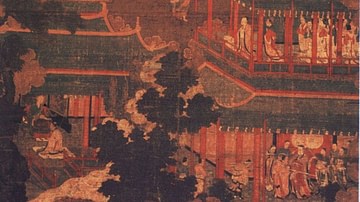
Goryeo
Goryeo (Koryo) ruled Korea from 918 to 1392. The kingdom oversaw an unprecedented flourishing in culture and arts with developments in architecture, ceramics, printing, and papermaking. The kingdom was repeatedly invaded by the Mongols...

Image
Traditional Chinese Roof Tiles & Acroteria
A detail of a roof from the Forbidden Cty, Beijing. In ancient Chinese architecture the yellow tiles, curved roof, and dragon acroteria were all typical features of imperial buildings.
Image
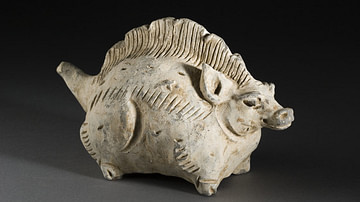
Chinese Pig-Dragon Sculpture
A Chinese pig-dragon sculpture. China, probably Yunnan Province, Yuan dynasty, 1279-1368.
Los Angeles County Museum of Art.
