
Search
Remove Ads
Advertisement
Search Results
Definition
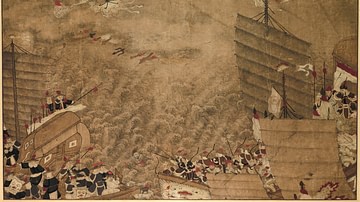
Wako - The Medieval Pirates of Southeast Asia
Wako (aka wokou and waegu) is a term used to refer to Japanese (but also including Chinese, Korean, and Portuguese) pirates who plagued the seas of East Asia from Korea to Indonesia, especially between the...

Interview
Interview: Korea-Japan Relations Through the Prism of Archaeology
Ancient East Asia was dominated by the three states known today as China, Japan, and Korea. The complex chain of successive kingdoms created a rich web of events that archaeologists have...

Definition
Emperor Taizong of Tang
Taizong (birth name, Li-Shimin, l. 598-649 CE, r. 626-649 CE) was the second emperor of the Tang Dynasty and is considered one of the greatest rulers in Chinese history for his reforms of the government and the laws, his...

Image
Chinese Terracotta Warrior
A portion of the Terracotta Army, the clay life-size army in the tomb of the Qin emperor Shi Huangdi. c. 210 BCE, Shaanxi Province, China.

Image
Chinese Dragon Roof Tile
A glazed ceramic roof tile depicting a dragon. Nanjing, Ming dynasty, 1366-1400.
The British Museum, London.

Image
Neolithic Chinese Jar
This jar dates from the 26th century BCE and is made of earthenware with pigments. It was made by the Majiayao Yangshao culture during the Banshan phase (c. 2655-2330 BCE). (Iris & B. Gerald Cantor Center for Visual Arts at...
Image
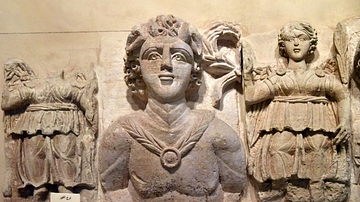
Taurus from the Adh-Dharish Temple Facade
This statue of Taurus was part of the temple's facade. The temple was designed according to classical fashion. It contains major constitutional elements of classical architectural order, but its decoration...

Video
Ancient Chinese Inventions
This video describes the many inventions of ancient China extending to the Early Middle Ages, and how these innovations impacted other aspects of Chinese history.

Image
Chinese Eunuchs
A mural depicting a group of eunuchs, the slaves and influential advisors of many Chinese emperors. Mural from the tomb of the prince Zhanghuai, 706 CE, Qianling, Shaanxi, China.

Image
Chinese Diamond Sutra
The Buddhist text known as the Diamond Sutra is believed to be the oldest surviving printed book in the world, dated to 868 CE and written in Chinese. This work is one of the most important works of the Buddhist tradition.
