
Search
Remove Ads
Advertisement
Search Results

Definition
Parthia (Empire)
The Parthians ruled from 247 BCE to 224 CE creating a vast empire that stretched from the Mediterranean in the west to India and China in the east. East of the Caspian Sea there emerged from the steppe of Central Asia a nomadic...

Definition
Emperor of Japan
The emperor of Japan is a position as the head of state which traditionally dates back to the 7th century BCE and the legendary figure of Emperor Jimmu (r. 660-585 BCE). Emperors came to be known as the Tenno or 'heavenly sovereign'...

Definition
Mongol Warfare
The Mongols conquered vast swathes of Asia in the 13th and 14th century CE thanks to their fast light cavalry and excellent bowmen, but another significant contribution to their success was the adoption of their enemies' tactics...

Definition
Samguk Yusa
The Samguk yusa ('Memorabilia of the Three Kingdoms') is a 13th-century CE text which covers the history and legends of Korea's founding right up to the 10th century CE. It is a sequel of sorts to the earlier Samguk sagi ('Records...

Definition
Korean Pottery
The pottery of ancient Korea stretches back to prehistory when simple brown wares were made and decorated with geometrical incisions. Potters would benefit from the ideas and techniques of their Chinese counterparts and go on to...

Definition
Lumbini
Lumbini is a village, archaeological site, and place of pilgrimage honored as the birthplace of Siddhartha Gautama (the Buddha, l. c. 563-483 BCE) located in modern-day Rupandehi District of Nepal, Province 5, near the Indian border...

Definition
Harsha
Emperor Harshavardhana, better known as Harsha, lived from 590 to 647 CE and was the last ruler of the Vardhana Empire, the last great empire in ancient India before the Islamic Invasion. He ruled from 606 CE to 647 CE. After Harshavardhana's...

Definition
Nara Period
The Nara Period (Nara Jidai) of ancient Japan (710-794 CE), so called because for most of that time the capital was located at Nara, then known as Heijokyo, was a short period of transition prior to the significant Heian Period. Despite...

Definition
Kapilavastu
Kapilavastu (“Place of Kapila”) is the name of the city where Siddhartha Gautama (the Buddha, l. c. 563-483 BCE) grew up and lived for the first 29 years of his life before leaving to pursue the spiritual path which led to his enlightenment...
Definition
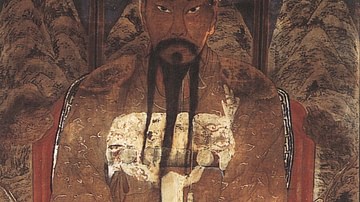
Dangun
Dangun Wanggeom (or Tangun) was the legendary founder of Gojoseon (Gochoson or Old Choson), the first Korean state which ruled northern Korea in the second half of the first millennium BCE. Gojoseon possessed the most advanced culture...
