
Search
Remove Ads
Advertisement
Search Results

Image
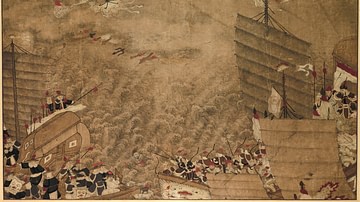
Korean & Chinese Forces Attacking the Japanese Fort of Ulsan
A painting showing Chinese and Korean forces attack the Japanese fort of Ulsan in southern Korea during the Japanese invasions of Korea between 1592 and 1598 CE, otherwise known as the ‘Imjin...
Image
Wako & Chinese Naval Battle
An 18th century CE illustration showing a naval battle between Japanese pirates (wako) and Chinese naval ships. (Rijksmuseum, Amsterdam)

Image
Chinese Shoe for a Bound Foot
A Chinese silk shoe designed to be worn by a woman with bound-feet. 18th century CE. (Musées du château des Rohan, Musée Louise Weiss, Saverne, France)

Image
Chinese Junk Ship
A 19th century CE oil painting of a traditional Chinese junk ship, used for ocean-going trade voyages since medieval times. (National Maritime Museum, Greenwich, London)
Image
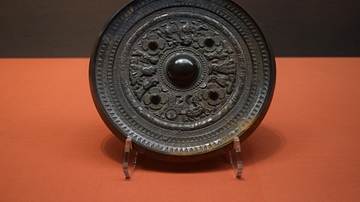
Chinese Bronze Mirror
Engraved Chinese bronze mirror with a deity and horse carriage design. From the 4th-5th century CE Samitatakarazuka Tumulus, Japan. From 2nd-3rd century CE China. Important Cultural Property. (Tokyo National Museum)

Image
Chinese Jade Cormorant
A Chinese jade plaque of a cormorant and fish. 1100-900 BCE. Height: 4 cm. (British Museum, London)

Image Gallery
Artistic Expression in Ancient China
Art in the ancient world was initially associated with ceremonial ritual but, in time, began featuring subjects related to everyday life. The Chinese were among the first civilizations to create a narrative of...

Article
Elephants In Ancient Indian Warfare
Elephants were used in the ancient Indian army, irrespective of regions, dynasties, or points in time; their importance was never denied and continued well into the medieval period as well. The ready availability...

Article
Gender & Identity in Mulan: Text & Commentary
The legend of Mulan, now world-famous thanks to the Disney films of 1998 and 2020, is the story of a young girl who disguises herself as a man to take her aged father's place as a conscript in the army...

Video
The Lives of Women in Ancient China
In Ancient China, it was widely known that it was better to be born a male than a female. To be born a female meant being subordinate to one’s father, then to one’s husband and if a wife became a widow, then she...
