
Search
Remove Ads
Advertisement
Search Results

Article
Mulan: The Legend Through History
Mulan (“magnolia”) is a legendary character in Chinese literature who is best known in the modern day from the Disney filmed adaptations (1998, 2020). Her story, however, about a young girl who takes her father's...
Image
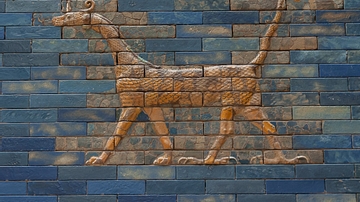
Dragon from the Ishtar Gate
Detail from the Ishtar Gate of Babylon, built in 6th century BCE by king Nebuchadnezzar II; part of the Gate is now reconstructed in Pergamon Museum in Berlin.

Definition
Ancient Japan
Ancient Japan has made unique contributions to world culture which include the Shinto religion and its architecture, distinctive art objects such as haniwa figurines, the oldest pottery vessels in the world, the largest wooden buildings...

Collection
Ancient Chinese Philosophers
The philosophers of ancient China developed diverse systems of thought, often in conflict with each other, all aiming to provide people with the means to live in harmony with themselves and others. Each philosopher understood...

Definition
Ming Dynasty
The imperial Ming dynasty ruled China from 1368 to 1644. It replaced the Mongol Yuan dynasty which had been in power since the 13th century. Despite challenges from abroad and within, the Ming dynasty oversaw an unprecedented growth...

Interview
Rubin Museum's Faith and Empire: Tibetan Buddhist Art
Faith and Empire: Art and Politics in Tibetan Buddhism, a new exhibition at the Rubin Museum of Art in New York, explores the dynamic historical intersection of politics, religion, and art as reflected...

Collection
Chinese Philosophy
Ancient Chinese Philosophy developed during the Spring and Autumn Period (c. 772-476 BCE) and the Warring States Period (c. 481-221 BCE) in ancient China. This was the era known as the Hundred Schools of Thought, referring to...

Image
Dragon-Turtle Celadon
A celadon (greenware) ceramic kettle in the form of a mythical dragon-turtle creature. Korea, Goryeo dynasty, 918-1392.
National Museum of Korea, Seoul.

Image
Celadon Fish-Dragon Ewer, Goryeo Dynasty
A celadon fish-dragon ewer. 12th century CE, Goryeo Dynasty, Korea. (National Museum of Korea, Soul, South Korea)

Image
Susanoo & the Koshi Dragon
The Shinto god Susanoo searching the waters for the eight-headed dragon known as Yamato-no-Orochi or the Koshi. (19th century CE print by Utagawa Kuniyoshi)
