
Search
Remove Ads
Advertisement
Search Results
Article
Archers in Ancient Chinese Warfare
The bow was the most common weapon in ancient Chinese warfare and the skill of using it was the most esteemed martial art for millennia. Archers were used as infantry, chariot riders, and cavalry over the centuries...

Article
Mongol Multiculturalism
The Mongol Empire accepted and promoted many other cultures. Historians often talk about cultural exchange across Asia in the Mongol Empire as something that was just facilitated by peace and stability across such a huge...

Article
Chariots in Ancient Chinese Warfare
The chariot was used in Chinese warfare from around 1250 BCE but enjoyed its heyday between the 8th and 5th century BCE when various states were constantly battling for control of China. Employed as a status symbol...

Article
Fortifications in Ancient Chinese Warfare
While ancient Chinese warfare was often characterised by large armies in pitched battles, siege warfare and the sacking of cities were also regular features. Huge earth walls with towers and encircling ditches...

Definition
Kublai Khan
Kublai Khan (Qubilai-Qan) was the ruler of the Mongol Empire from 1260 to 1294. His accomplishments include establishing Mongol rule in China under the name of the Yuan Dynasty (1271-1368), thus becoming the first non-Chinese to rule...

Article
Armour in Ancient Chinese Warfare
With zinging arrows, powerful crossbow bolts, stabbing swords, and swinging axes all a staple feature of the Chinese battlefield, it is not surprising that soldiers sought to protect themselves as best they could...
Image
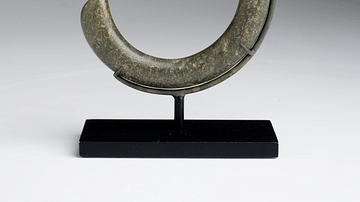
Hongshan Jade Dragon
The jade dragon from Hongshan, Inner Mongolia, China. Dating to between 4500 and 3000 BCE, it is the earliest known depiction of a dragon. National Museum of China, Beijing. Image by David Owsley Museum, used with permission...

Definition
Zhou Dynasty
The Zhou Dynasty (1046-256 BCE) was among the most culturally significant of the early Chinese dynasties and the longest lasting of any in China's history, divided into two periods: Western Zhou (1046-771 BCE) and Eastern Zhou (771-256...

Image
Han Dynasty Jade Dragon
A carved jade dragon. Han dynasty, 2nd-1st century BCE.
The British Museum, London.

Definition
Book of Revelation
The book of Revelation or the Apocalypse of John of Patmos is one of the most famous books in the New Testament. Written near the end of the 1st century CE, it is the only apokalypsis (Greek: "unveiling of unseen realities"...
