
Search
Did you mean: Serapis?
Remove Ads
Advertisement
Search Results

Definition
Ancient Korean Architecture
The architecture of ancient Korea is epitomised by the artful combination of wood and stone to create elegant and spacious multi-roomed structures characterised by clay tile roofing, enclosures within protective walls...

Definition
Pottery in Antiquity
Pottery is the first synthetic material ever created by humans. The term refers to objects made of clay that have been fashioned into the desired shape, dried, and either fired or baked to fix their form. Due to its abundance...

Image
Silla Ceramic Warrior
A ceramic ewer in the form of a warrior on horseback. 5-6th century CE, Silla Kingdom, Korea. (National Museum of Korea, Seoul, South Korea)

Image
Silla Ceramic Oil Lamp
A ceramic oil lamp from the Silla kingdom of ancient Korea. 5-6th century CE. (National Museum of Natural History, Washington, DC, USA)

Image
Korean Celadon Maebyeong
A maebyeong celadon (greenware) vase from the Goryeo dynasty of ancient Korea. The inlay design has typical Buddhist motifs of cranes and clouds. Late 12th century CE. National Treasure No. 68. (Kansong Museum of Fine Arts...
Image
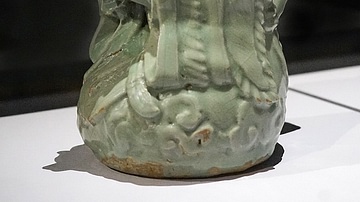
Taoist Figure Celadon Pitcher, Goryeo Dynasty
A celadon pitcher in the form of a Taoist figure. Goryeo Dynasty, 12th century CE, Korea. (National Museum of Korea, Seoul, South Korea)

Image
Dragon-Turtle Celadon
A celadon (greenware) ceramic kettle in the form of a mythical dragon-turtle creature. Korea, Goryeo dynasty, 918-1392.
National Museum of Korea, Seoul.

Video
Silla Earthenware
Gray-blue, unpolished earthenware objects were crafted in the Gyeongsang-do region during the Silla period, and they are generally referred to as Silla earthenware. Silla earthenware was first made mainly in the Gyeongju and...
Image
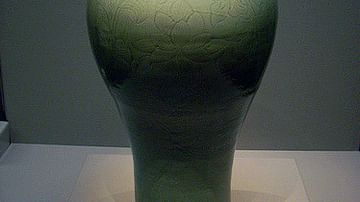
Maebyeong Celadon Vase, Goryeo Dynasty
A maebyeong celadon vase with lotus decoration. 12th century CE, Goryeo Dynasty, Korea. (National Museum of Korea, Seoul, South Korea)
Image
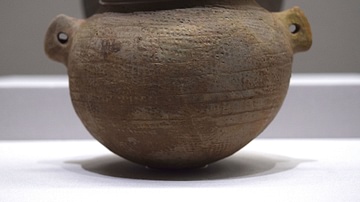
Ancient Korean or Japanese Jar
This jar was excavated from a box-style stone coffin in Daishogunyama Tumulus on Tsushima, the Japanese island closest to the Korean peninsula. Its round body was created by lightly beating the outer surface of the...
