
Search
Did you mean: Aria?
Remove Ads
Advertisement
Search Results

Definition
Rhodes
Rhodes, with an area of 1,400 km², is the largest island in the Greek Dodecanese group located in the south-eastern Aegean. The island was an important protagonist in wider Greek and Mediterranean affairs throughout the Bronze Age, Archaic...

Definition
Phrygia
Phrygia was the name of an ancient Anatolian kingdom (12th-7th century BCE) and, following its demise, the term was then applied to the general geographical area it once covered in the western plateau of Asia Minor. With its capital...

Definition
Sardis
Sardis (near modern-day Sart, Turkey) was the capital of the ancient Kingdom of Lydia founded (according to Herodotus) by the Heracleidae, the Heraclid Dynasty descended from the hero Heracles (Hercules). The city was famous in antiquity...

Definition
Tyche
In Greek mythology, Tyche is the goddess and personification of good luck, chance, and fortune. Tyche's popularity grew after the Classical period when many cities and officials across the Greek world and the Mediterranean adopted her...

Definition
Coinage
Coins were introduced as a method of payment around the 6th or 5th century BCE. The invention of coins is still shrouded in mystery: According to Herodotus (I, 94), coins were first minted by the Lydians, while Aristotle claims that...

Definition
Ancient Persian Governors
The Achaemenid Persian Empire functioned as well as it did because of the efficient bureaucracy established by its founder Cyrus the Great (r. c. 550-530 BCE) which was administered through the satrapy system. A Persian...

Definition
Ancient Cyprus
Cyprus is a large island located in the eastern Mediterranean Sea, east of Greece, south of Asia Minor, west of the Levant, and north of Egypt. The naming of the island is a matter of dispute amongst historians. One theory suggests...

Definition
Antigonus I
Antigonus I Monophthalmus ("the One-Eyed") (382 -301 BCE) was one of the successor kings to Alexander the Great, controlling Macedonia and Greece. When Alexander the Great died in 323 BCE, a conflict known as the Wars of the Diadochi...
Definition
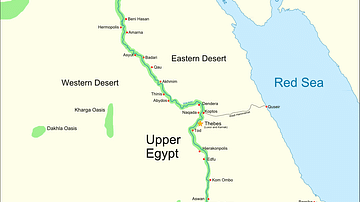
Dodekaschoinos
The Dodekaschoinos (literally "Twelve Cities" in Greek) was the name of a region in Lower Nubia that became an important province of the Ptolemaic Kingdom after it was annexed from Meroitic Nubia by the Egyptian kingdom. The area...

Definition
Telesilla of Argos
Telesilla of Argos was a lyric poet of the 5th century BCE, listed by Antipater of Thesalonike (c. 15 BCE) as one of the great Nine Female Lyric Poets of Greece (along with Praxilla, Moiro, Anyte, Sappho, Erinna, Corinna, Nossis...
