
Search
Did you mean: Cronus?
Remove Ads
Advertisement
Search Results
Image
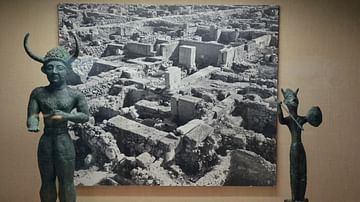
Bronze Horned God & Ingot God from Enkomi, Cyprus
Two bronze statuettes from Enkomi dated to the early 12th century BCE, Cyprus Museum. The statuette on the left is the so-called “Horned God” which depicts a deity portrayed as a young athlete wearing a horned helmet. The statuette on the...

Image
Bronze & Gold Mycenaean Sword
A bronze Mycenaean sword with a gold handle inlaid with lapis lazuli, from Mycenae, Grave IV, Grave Circle A, 16th century BCE.
National Archaeological Museum, Athens.

Image
Bronze Bust of Juba II
A bronze bust of Juba II as a young man, created sometime in the 20s BCE. The bust was found in Volubilis, the western capital of Mauretania during the reign of Juba II.
(Collection of the Rabat Archaeological Museum, Morocco)

Image
Shang Dynasty Bronze Zun
A bronze vessel (zun) with the form of a double-ram. Shang Dynasty, 1200-1050 BCE, China. (British Museum, London)

Image
Bronze Cat from Egypt
Hollow-cast bronze cat, probably a votive offering to the goddess Bastet, from Tell Basta, Egypt, c. 664-30 BCE.
National Museum of Scotland, Edinburgh.
Image
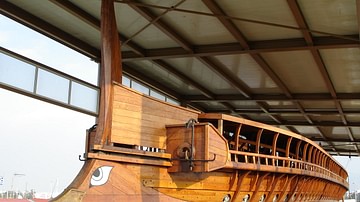
Trireme Hull with Bronze Ram
The hull of the Olympias, a full-scale reconstruction of an ancient Greek trireme warship. The principal strategy in battle of the trireme was to sink or damage the oars of an enemy vessel using the bronze ram fixed to the ship's prow. Triremes...
Image
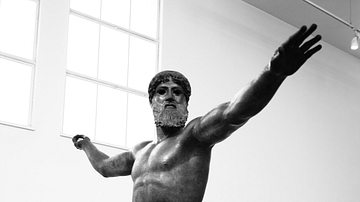
The Artemision Bronze
The Artemision Bronze is a slighter larger than life sized statue recovered from the sea off Cape Artemision that represents either Zeus or Posiedon; the right hand either originally held a thunderbolt or a trident. The statue's creation...
Image
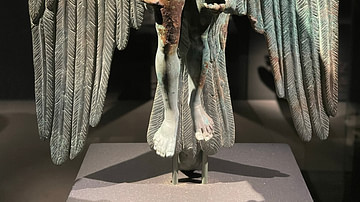
Bronze Lamp from Vani with Zeus and Ganymede
A three-nozzled bronze lamp featuring the god Zeus in the form of an eagle, carrying the boy Ganymede off to Mount Olympus to be his cupbearer. When the lamp was lit, the beautiful youth would gleam, and the divine bird would be encircled...

Image
Phoenician Bronze Bowl from Nimrud
Over 150 bronze bowls were found in a palace at the city of Nimrud. These bowls were made in Phoenicia (modern-day Lebanese and Syrian coasts), and were brought to Nimrud as tribute or booty by one of the kings who campaigned in the west...

Image
Etruscan Bronze Warrior
An Etruscan bronze warrior statuette. Populonia, 5th century BCE. Height: 26 cm. (Metropolitan Museum of Art, New York)
